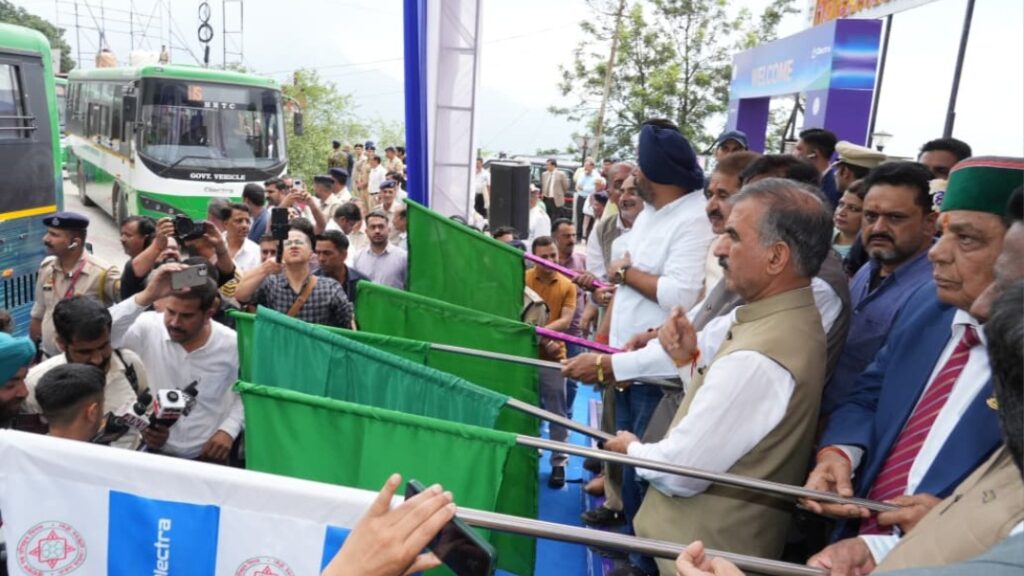
Sukhu announces procurement of 1,000 electric buses and 100 hydrogen buses
Flags off 297 new electric buses of HRTC
Chief Minister Thakur Sukhvinder Singh Sukhu today flagged off 297 new Type-I electric buses from Kyarighat in Solan district for deployment across various depots of the Himachal Road Transport Corporation (HRTC) marking a significant milestone in the history of public transportation in Himachal Pradesh. The induction of these electric buses will not only enhance commuter convenience but also represents a major step towards establishing a clean, green, modern and sustainable public transport system. The Chief Minister also launched the ‘HimBus Plus Card’ on this occasion which is another significant initiative aimed at promoting digital and smart public transportation in the state.
The Chief Minister said that these state-of-the-art electric buses would provide passengers a safe, comfortable and pollution-free travel experience. Their operation would reduce dependence on fossil fuels, significantly lower carbon emissions besides decreasing operational costs and strengthening the financial position of HRTC. The state government has developed modern charging infrastructure at various bus depots to ensure the seamless operation of these buses and has put in place all necessary arrangements to promote e-mobility across the state.
Shri Sukhu reiterated the state government’s commitment to environmental conservation and sustainable development. He said that the objective was not only to provide better transportation facilities but also to ensure a clean Himalaya, clean air and a healthy environment for future generations. The expansion of the electric bus fleet reflects this long-term vision of the state government.
Highlighting the benefits of the HimBus Plus Card, the Chief Minister said that it would offer passengers a modern, digital and cashless travel experience. Regular passengers would receive a five percent discount on bus fares, while senior citizens would be entitled to a 15 percent concession. In addition, passengers would be eligible for cash back up to Rs. 2,000 per month, depending on their monthly usage of HRTC services.
Later, while interacting with the media persons, the Chief Minister stated that with the induction of these 297 buses, the total number of electric buses in the HRTC fleet has now reached 500. He pointed out that electric buses were considerably more economical than diesel buses. The operational cost of an electric bus, including staff and other expenses, was approximately Rs. 36-38 per kilometre, compared to Rs.76-86 per kilometre for a diesel bus. With addition these buses in the fleet, savings of Rs. 40-50 per kilometre would be ensured to HRTC. He added that the present state government was working towards making HRTC financially self-reliant.
The Chief Minister announced that the state government would procure 1,000 additional electric buses during the current year with the tendering process to commence shortly. The government was also considering the procurement of 100 hydrogen-powered buses to protect the state’s natural environment from the adverse impacts of climate change and to position Himachal Pradesh as a leading green energy state in the country.
He said that the government had envisioned making Himachal Pradesh a green energy state in its very first budget and accordingly prioritised the promotion of electric mobility. He noted that the current electric buses had a range of around 200 kilometers per charge, while the next generation of buses would be capable of travelling 250 to 300 kilometers on a single charge. These buses were being procured by the government as part of its broader strategy to make HRTC self-sustaining.
The Chief Minister also stated that during the previous BJP government’s tenure, the HRTC employees and pensioners often faced delays of up to two months in receiving salaries and pensions. He said that the present government had ensured the timely disbursement of salaries and pensions.
He further said that the state government was working with a vision to make Himachal Pradesh a self-reliant state by 2027. Referring to financial matters, he alleged that the Revenue Deficit Grant (RDG), which Himachal Pradesh had been receiving from the centre from 1952 to 2026 ranging between Rs. 8,000 crore and Rs. 10,000 crore annually was discontinued following the recommendations of the 16th Finance Commission. This decision had adversely affected the interests of the people of the state. He maintained that despite these challenges, the present government had closed avenues of corruption and was working steadily towards achieving financial self-reliance.
The Chief Minister also criticised the previous government for failing to adequately safeguard the state’s assets and claimed that the present government had taken decisive steps to protect public resources. He said that the government had secured Rs. 421 crore from Wildflower Hall hotel and Rs.150 crore from JWS. He further stated that the Kishau hydroelectric project was expected to generate Rs. 1,000 crore in revenue for the state.
Himachal Pradesh has made a precondition that Haryana government should release BBMB arrears pending since 2011 before signing the agreement on the Kishau project. He asserted that despite favourable legal decisions, the arrears had not yet been released by the neighbouring states and reaffirmed the government’s commitment to securing what he described as the rightful dues of the people of Himachal Pradesh.
Deputy Chief Minister Mukesh Agnihotri, Health and Family Welfare Minister Dr. (Col.) Dhani Ram Shandil, MLAs Hardeep Bawa and Kuldeep Rathore, Congress leader Shiv Kumar, Chief Minister’s Advisor (Infrastructure) Anil Kapil, Additional Chief Secretary Onkar Chand Sharma, Managing Director, HRTC Dr. Nipun Jindal, Deputy Commissioner Shimla Anupam Kashyap, Deputy Commissioner Solan Manmohan Sharma and other dignitaries were present on the occasion.