Reviving Indian Knowledge, Ethics and Cultural Values Key to Nation-Building: Lokmanya Tilak Seminar Concludes at IIAS
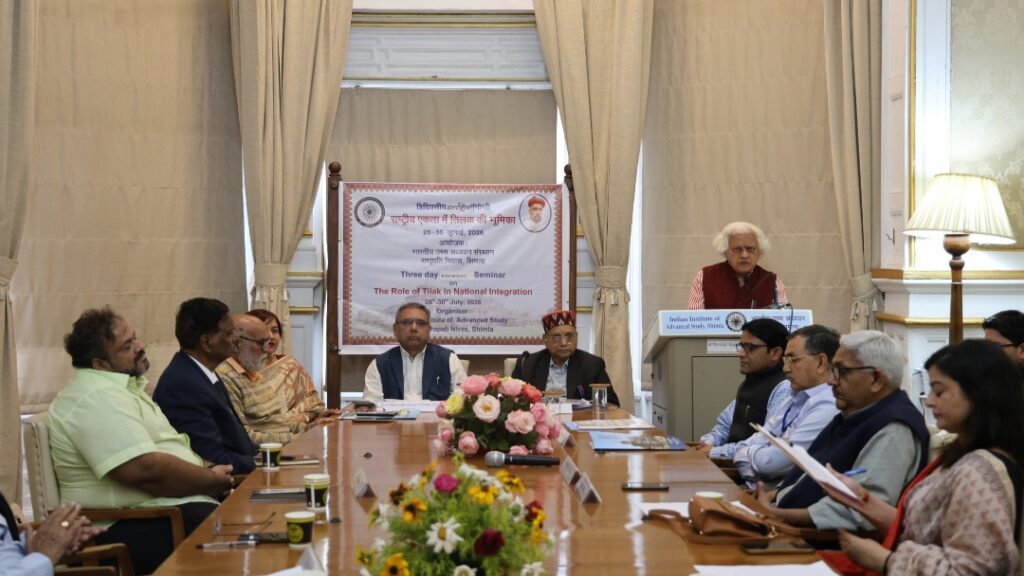
The three-day International Seminar on “The Role of Tilak in National Integration”, organized by the Indian Institute of Advanced Study (IIAS), Rashtrapati Niwas, Shimla, concluded successfully today. Bringing together eminent academicians, philosophers, historians, literary scholars and researchers from India and abroad, the seminar witnessed extensive scholarly deliberations on various dimensions of Lokmanya Bal Gangadhar Tilak’s nationalist thought, cultural renaissance, Karmayoga, Swaraj, Swadeshi, religious pluralism and the Indian Knowledge Tradition. The three-day deliberations reaffirmed that Tilak’s philosophy extended far beyond the freedom movement, providing a comprehensive intellectual foundation for India’s cultural identity, ethical consciousness and national integration.
Delivering the Valedictory Address, Professor Sunaina Singh, former Vice-Chancellor of Nalanda University, observed that India’s true strength lies in its rich knowledge traditions, cultural diversity and enduring ethical values. She remarked that Lokmanya Tilak did not merely inspire the nation towards political freedom but awakened a deeper sense of self-realisation, cultural confidence and intellectual independence whose relevance has become even more significant in the contemporary global context. She emphasized that the integration of the Indian Knowledge Tradition with modern education, research and public policy is the need of the hour. Universities, she said, should evolve into centres of knowledge that connect the foundational ideas of Indian civilization with contemporary global discourse while offering meaningful solutions to the challenges confronting humanity.
Professor Sunaina Singh further stated that institutions of higher education are not merely centres for imparting knowledge but are equally responsible for nurturing responsible, ethical and socially conscious citizens. Stressing the need to build meaningful linkages among education, culture, literature, environmental sustainability and global engagement, she observed that India’s intellectual heritage possesses the potential to provide alternative frameworks for addressing contemporary global challenges. Describing Lokmanya Tilak’s ideas as a bridge between the Indian Knowledge Tradition and the modern global worldview, she noted that his concepts of Swaraj, Karmayoga and cultural self-respect continue to inspire holistic social and national development.
Presiding over the valedictory session, Professor Shashi Prabha Kumar, Chairperson, IIAS, remarked that Lokmanya Tilak’s philosophy forms one of the foundational pillars of India’s national consciousness. She stated that national integration is not merely a political construct but an outcome of shared cultural values, ethical responsibility, social harmony and historical consciousness. In the prevailing global scenario, she emphasized, the revitalisation of India’s knowledge traditions and cultural values has become increasingly important, and academic seminars of this nature play a significant role in transmitting India’s rich intellectual heritage to younger generations.
In his address, Professor Himanshu Kumar Chaturvedi, Director, IIAS, said that the Institute remains committed to promoting serious academic discourse capable of reinterpreting India’s philosophical, cultural and historical traditions in the light of contemporary challenges. He observed that the three-day international seminar had provided scholars with an opportunity to examine Lokmanya Tilak’s ideas from fresh interdisciplinary perspectives while fostering meaningful dialogue across diverse fields of study.
Presenting the overall report of the seminar, Professor R. C. Sinha, National Fellow at IIAS and Convener of the seminar, stated that scholars representing universities and research institutions from India and abroad presented research papers examining the multidimensional contributions of Lokmanya Tilak. He observed that Tilak should be understood not merely as a political leader, but also as a philosopher, thinker, educationist, journalist, cultural revivalist and one of the foremost architects of modern India’s intellectual consciousness. He expressed confidence that the research papers presented during the seminar would serve as valuable reference material for future scholarship on Tilak.
The technical sessions of the seminar featured scholarly discussions on a wide range of themes, including Tilak’s nationalism, cultural nationalism, the concept of Swaraj, Gita Rahasya, Karmayoga, Lokasangraha, Swadeshi, religious pluralism, the Indian Knowledge Tradition, education, decolonization, geo-cultural nationalism, Tilak’s contribution to modern India and national integration. The deliberations consistently highlighted that Tilak’s philosophy not only strengthened India’s cultural self-consciousness but also offered a compelling intellectual framework for inclusive and responsible nation-building.
The three-day seminar witnessed participation from scholars representing universities and academic institutions across India as well as from abroad. Presentations delivered by experts in philosophy, history, political science, literature, Sanskrit studies, cultural studies and the Indian Knowledge Tradition offered fresh perspectives on Lokmanya Tilak’s thought in contemporary national and global contexts. The discussions repeatedly underscored that India’s civilizational wisdom continues to possess the capacity to address many of the social, cultural and ethical challenges confronting the modern world.
During the various technical sessions, eminent scholars from India and abroad presented papers on diverse aspects of Tilak’s philosophy. Professor Anil Kumar Prasad, Professor of English based in Libya, examined Tilak’s nationalism, cultural resistance and the discourse of decolonization. Professor D. N. Tiwari, former Head of the Department of Philosophy and Religion, Banaras Hindu University, offered a philosophical analysis of Gita Rahasya in the context of Tilak’s response to criticisms of the doctrine of Niṣkāma Karma. Professor Veenu Pant of Sikkim University analysed the concept of geo-cultural nationalism through Gita Rahasya, while Professor Dwarka Nath, Yogiraj Gambhir Nath UGC Chair Professor at Deen Dayal Upadhyaya Gorakhpur University, elaborated on Tilak’s concept of Lokasangraha and its contemporary relevance.
Professor Uma C. T. Vaidya, Tagore Fellow at IIAS, presented a critical study of Tilak’s celebrated work The Arctic Home in the Vedas, while Professor (Dr.) Ramnath Pandey of The Maharaja Sayajirao University of Baroda examined the idea of indigenous Aryanism and cultural identity in relation to national integration. The technical sessions, chaired by eminent scholars including Professor H. M. Budhauliya, Professor D. D. Sharma, Professor Sanjay Paswan, Professor M. M. Pathak, Professor Sachidananda Mohanty and Professor G. P. Das, also featured presentations by Professor O. P. Sharma, Professor Sunil Kumar Singh, Dr Pravin K. Patel, Dr Deshraj Siraswal, Dr Lakhan Jain, Dr Sudhir Singh, Professor Brijendra Pandey, Dr Avishek Ray, Dr Rajani Chaubey, Professor Laxman D. Satya (Commonwealth University of Pennsylvania, USA), Dr Jahira Khatun, Shri Sudhanshu Ranjan, Professor S. Ranganath, Dr Sopan Shinde, Dr Swapna Mitra, Dr Anuradha Raturi, Dr Balaji Chirade, Professor Balaganapathi Devarakonda, Dr Arun Garg and Professor Rishikant Pandey. Their papers generated meaningful discussions on cultural nationalism, Swaraj, Karmayoga, Lokasangraha, religious pluralism, Indian Knowledge Systems, Swadeshi, education, Tilak’s contribution to modern India and the continuing relevance of national integration.
The concluding session also reaffirmed that Lokmanya Tilak’s historic proclamation, “Swaraj is my birthright,” represented far more than a political demand; it embodied a comprehensive vision of building a self-reliant, culturally awakened and ethically empowered society. His concepts of Karmayoga, Lokasangraha, Swadeshi and cultural nationalism continue to offer enduring guidance to India’s intellectual, social and national life.
During the valedictory session, the detailed seminar report was presented by Dr Jahira Khatun, Fellow, IIAS. The proceedings were moderated by Dr Akhilesh Pathak, Public Relations Officer, IIAS. The programme concluded with a formal Vote of Thanks proposed by Dr Rajeev Kumar Mishra, Librarian and Academic Resource Officer, IIAS, who expressed gratitude to all the distinguished guests, scholars, researchers, participants and everyone associated with the successful organisation of the seminar.