Gridlock in the Hills: Lawyers’ Protest Exposes Shimla’s Growing Traffic Troubles
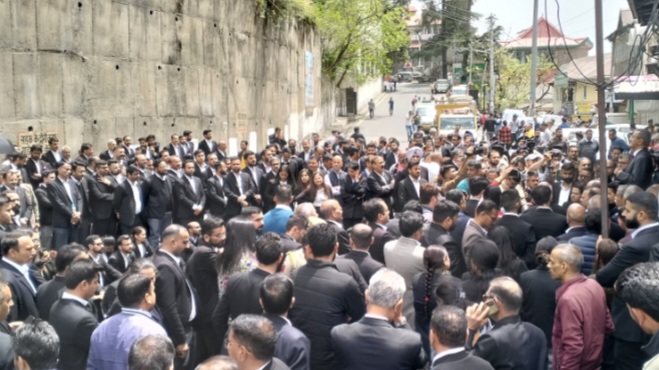
Shimla witnessed an unusual and chaotic day on Tuesday as a protest by lawyers over a steep hike in sealed road pass fees brought the city’s traffic to a near standstill. For more than three hours, key roads in the heart of the capital remained choked, leaving commuters stranded, office-goers late, and daily routines badly disrupted. What began as a protest against rising costs soon unfolded into a much larger conversation about traffic management, fairness in rule enforcement, and the shrinking space for pedestrians in the hill city.
The immediate trigger for the agitation was the government’s decision to significantly increase the fee for accessing sealed roads—restricted routes that connect important institutions, including the Himachal Pradesh High Court. Under the revised policy, not only have the annual permit charges gone up sharply, but penalties for unauthorised entry have also become stricter. Lawyers, who rely on these routes daily for court-related work, argued that the decision places an unnecessary financial burden on them.
However, the protest quickly took an unexpected turn. In a striking move, lawyers began stopping vehicles on sealed roads and checking whether drivers had valid passes. During this exercise, several government officers and officials were reportedly found using these restricted roads without proper authorisation. Challans were issued on the spot, bringing an uncomfortable truth into the spotlight—rules may exist on paper, but their enforcement often appears selective.
This development amplified a long-standing concern among residents: are traffic regulations being applied uniformly, or do certain individuals enjoy informal exemptions? If sealed roads are meant to regulate vehicle movement and reduce congestion, the question arises—how many unauthorised vehicles use them daily without consequence?
The controversy has revived the debate around the very purpose of sealed roads. These routes were originally introduced to ease traffic pressure in Shimla’s congested core and to preserve pedestrian-friendly spaces in a city known for its walkability. Over time, however, increasing permits, alleged violations, and frequent demands for exemptions have weakened their effectiveness.
Tuesday’s events made it clear that the issue goes far beyond lawyers or permit holders. Shimla is facing a broader and growing traffic crisis. Designed decades ago for a much smaller population and far fewer vehicles, the city is now struggling to cope with thousands of cars entering daily. Its hilly terrain and limited space leave little room for road expansion, making congestion almost inevitable.
Today, traffic jams are a routine sight on major stretches like Cart Road, Circular Road, Chhota Shimla, Sanjauli, Khalini, and near the Victory Tunnel. During peak hours, vehicles crawl for kilometres, testing the patience of commuters. The situation worsens during tourist seasons, when overflowing parking areas spill onto roads, creating bottlenecks across the city.
Ironically, Shimla—once celebrated for its pedestrian-friendly charm—is steadily becoming more vehicle-centric. Footpaths are increasingly encroached upon, public spaces are shrinking, and residents often find themselves competing with traffic in areas that were originally meant for walking.
The challenges before the government are complex. With limited land, fragile terrain, and a rising number of vehicles, managing mobility in Shimla is no easy task. While restricting access to certain roads may seem like a logical step, many residents feel that traffic management cannot be reduced to permits and fee hikes alone. What the city needs is a more comprehensive and sustainable mobility plan.
Parking remains one of the biggest concerns. Vehicles parked haphazardly along narrow roads further reduce already limited space, contributing to congestion. Although public transport has improved in certain pockets, it still does not offer a reliable or convenient alternative for many. This pushes more people towards private vehicles, adding to the problem.
The visible impact is hard to ignore—longer travel times, increased fuel consumption, rising pollution levels, and growing frustration among residents. For a hill town already grappling with unplanned urbanisation and environmental stress, worsening traffic only compounds the challenges.
In many ways, the lawyers’ protest served as a wake-up call. The fact that a single protest could bring large parts of the city to a halt highlights how fragile Shimla’s traffic system has become. It also exposed gaps in enforcement and raised valid questions about accountability and fairness.
While the debate over sealed road fees is likely to continue, the larger issue remains unchanged. Shimla’s traffic problem is no longer occasional or seasonal—it has become structural. Addressing it will require stronger public transport systems, better parking solutions, consistent enforcement of rules, and a renewed focus on preserving pedestrian spaces.
Ultimately, the protest was about more than just higher fees. It revealed a deeper reality—Shimla is struggling to keep moving because its infrastructure, policies, and planning are no longer keeping pace with its growth.