Governor calls for strengthening higher education to realise vision of ‘Atmanirbhar Bharat’
Governor Kavinder Gupta said that the vision of Atmanirbhar Bharat can be realised through a robust, inclusive and future-oriented education system. He stressed the need for continuous efforts to strengthen academic excellence and research activities in the universities through collective commitment and institutional innovation.
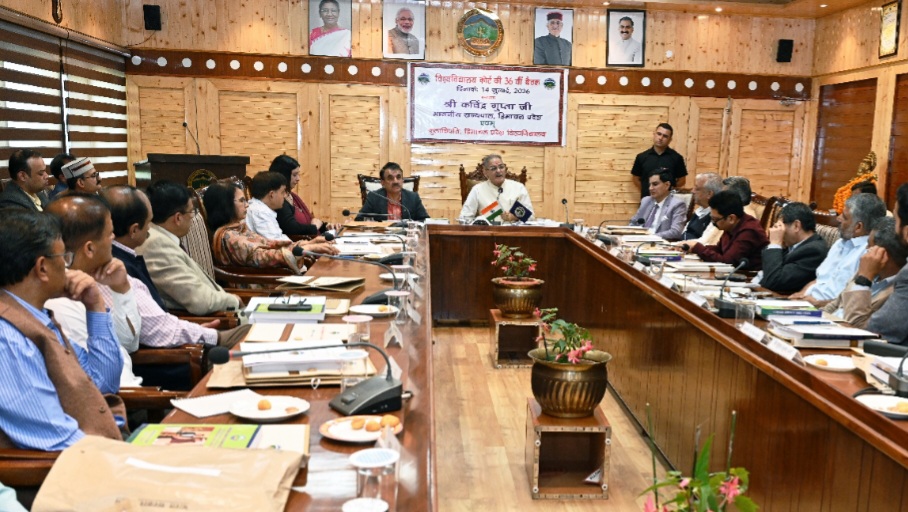
The Governor was presiding over the 36th meeting of the Himachal Pradesh University Court at Himachal Pradesh University here today.
Prior to the meeting, he inaugurated the University’s newly established digital studio/Mooc recording studio, where Director of the International Centre for Distance Education and Open Learning Dr. Pradeep Kumar briefed him about the studio’s role in expanding access to quality digital education.
Addressing the members of the University Court, Shri Gupta described Himachal Pradesh University as a premier institution of higher learning and research, serving not only the State but also the nation. He emphasized that the University must continuously enhance the quality of education and research to meet the demands of a rapidly changing world.
The Governor highlighted the importance of introducing academic programmes that combine theoretical knowledge with practical skills, innovation and entrepreneurship. Referring to emerging technologies, he said that expertise in artificial intelligence, data science, cyber security and green technology has become indispensable and urged the University to promote research and development in these fields.
Calling for greater institutional accountability, Shri Gupta directed that meetings of the University Court should be held regularly, preferably once every three months. He also stressed the need to clear all pending audit paras at the earliest to strengthen financial discipline and governance.
Emphasizing the social responsibility of educational institutions, the Governor suggested that every teacher should adopt a village and contribute towards promoting environmental conservation, self-reliance and community development.
Shri Gupta underlined that higher education must not be confined to technical and professional disciplines alone but should also nurture moral values, ethical conduct and India’s rich cultural heritage. He called for meaningful efforts to integrate the country’s ancient knowledge traditions with modern education in line with the objectives of the National Education Policy-2020.
Highlighting the employment challenges facing the youth, the Governor urged the University to promote skill-based education, entrepreneurship and the start-up ecosystem through incubation centres, industry-academia partnerships and internship programmes, enabling students to become job creators rather than job seekers.
He also stressed the importance of research and awareness in areas such as environmental protection, climate change, water conservation, waste management and sustainable development. Shri Gupta called for strengthening online education, virtual classrooms, digital libraries and the use of emerging technologies such as Artificial Intelligence and cloud computing to make education more accessible and effective.
The Governor further emphasized the need to enhance the University’s research ecosystem through state-of-the-art facilities, stronger collaboration with industry and greater efforts to secure national and international research grants.
Appealing to the teaching fraternity and the University administration, Shri Gupta urged them to work with greater dedication, discipline and innovation. He said that the true objective of education is not merely to award degrees but to prepare responsible citizens capable of contributing meaningfully to society and nation-building.
Earlier, Vice-Chancellor Prof. Mahavir Singh presented a report on the University’s major achievements and initiatives during the past year. He highlighted the establishment of five new centres, including the Centre for Green Energy and Nanotechnology, Centre for Artificial Intelligence on Cyber-Physical Systems, Centre for Pahari Culture and Heritage, Himalayan Centre for Disaster Risk Reduction and Resilience, and the Ramanujan Centre for Indian Knowledge Systems and Indian Mathematics, which are expected to strengthen the University’s academic profile.
The meeting also reviewed the implementation of the National Education Policy-2020. MLA Suresh Kumar was unanimously elected as a Member of the Executive Council. MLAs Harish Janartha, Suresh Kumar and Chandra Shekhar also shared valuable suggestions during the deliberations.
Registrar Jyoti Rana conducted the proceedings and proposed the vote of thanks.
Secretary (Education) Rakesh Kanwar was also present on the occasion.