Himachal Steps Up War Against Chitta with Tough Enforcement, Public Support and Rehabilitation Push
The Himachal Pradesh government has stepped up its campaign against chitta, adopting a multi-pronged strategy that goes beyond arrests and seizures. From tougher laws and financial investigations to community participation, youth engagement and rehabilitation, the government is seeking to tackle both the drug trade and the human cost of addiction.
Under Chief Minister Thakur Sukhvinder Singh Sukhu, the state has adopted a zero-tolerance approach towards drug trafficking, with the government maintaining that no offender should be protected because of political, financial or social influence.
A major legislative push came in March 2025 when the Himachal Pradesh Vidhan Sabha passed two Bills aimed at strengthening the legal framework against narcotics and organised crime. The Himachal Pradesh Drugs and Controlled Substances (Prevention, De-addiction and Rehabilitation) Bill, 2025 focuses on prevention, action against offenders, treatment and rehabilitation, while the Himachal Pradesh Organised Crimes (Prevention and Control) Bill, 2025 seeks stronger action against organised criminal networks, including those involved in drug trafficking.
The government says its enforcement drive has resulted in 5,642 narcotics-related cases and more than 8,250 arrests over a three-year period. Action was also taken against 139 government employees, including the dismissal of 15 state government employees and 22 police personnel.
The crackdown is increasingly targeting repeat offenders, organised supply chains and the money trail behind the illegal drug trade. Authorities are also mapping suspected drug networks at the panchayat level in an effort to identify trafficking patterns closer to the ground.
Action under the Prevention of Illicit Traffic in Narcotic Drugs and Psychotropic Substances (PIT-NDPS) Act has also been strengthened. By December 2025, 46 major drug traffickers had reportedly been detained under the law and illegal assets worth Rs 46 crore confiscated.
Financial investigations have become another key pillar of the campaign. Between 2024 and 2026, properties valued at around Rs 91.24 crore were frozen in 115 cases across Himachal Pradesh.
Police District Nurpur accounted for properties worth Rs 22.28 crore in 14 cases, followed by Solan with Rs 17.86 crore in 15 cases and Shimla with Rs 12.61 crore in 16 cases. Properties worth Rs 10.98 crore were frozen in Una, Rs 8.84 crore in Sirmaur, Rs 6.24 crore in Kangra, Rs 5.12 crore in Police District Baddi, Rs 3.62 crore in Mandi and Rs 2.19 crore in Bilaspur. Similar action was also reported in Police District Dehra and Kullu.
Year-wise, properties valued at Rs 25.43 crore were frozen in 2024, followed by Rs 23.98 crore in 2025 and Rs 41.42 crore in 2026, highlighting the growing emphasis on hitting trafficking networks financially.
Taking the Fight to the Community
The government is also trying to turn the anti-chitta campaign into a wider public movement.
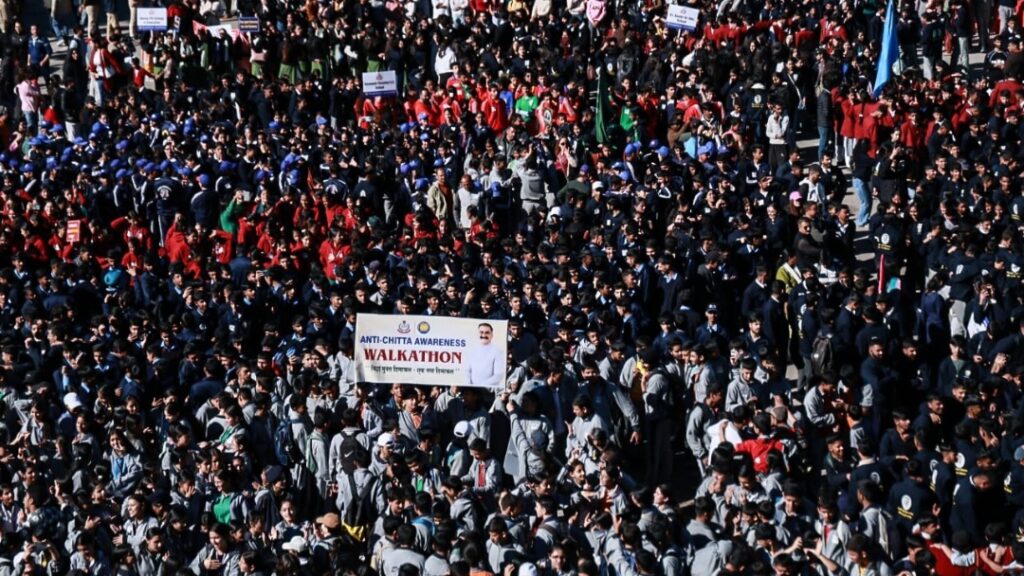
During an anti-chitta awareness walkathon in Dharamshala on 1 December 2025, Chief Minister Sukhu launched the Chitta Information Reward Scheme. Under the initiative, citizens providing information on drug trafficking can receive cash rewards ranging from Rs 10,000 to Rs 10 lakh, depending on the quantity involved, with rewards exceeding Rs 5 lakh specified for information related to major drug networks.
Information can be shared through emergency helpline 112, with confidentiality for informants emphasised. The government has also proposed setting up an Anti-Chitta Volunteer Team to improve coordination between local communities and the police.
At the same time, prevention efforts are increasingly focusing on young people. Through the Khelo Himachal-Chitta Mukt Himachal initiative, youngsters are being encouraged to take up sports and other constructive activities.
Anti-chitta walkathons held in Shimla, Dharamshala, Hamirpur, Una and Bilaspur have sought to spread awareness and encourage families and communities to play a more active role in protecting young people from substance abuse.
Rehabilitation Alongside Enforcement
Recognising that the challenge cannot be addressed through policing alone, the government is also expanding treatment and rehabilitation facilities for people struggling with substance dependence.
Nav-Jeevan, the women’s de-addiction and rehabilitation centre at Mashobra, provides specialised medical treatment, psychological counselling, accommodation and rehabilitation support.
Another de-addiction and rehabilitation centre is planned at Dr Rajendra Prasad Government Medical College, Tanda. A modern 100-bed facility at Kotla Barog in Sirmaur district is also being developed to increase the state’s treatment and rehabilitation capacity.
The government has further constituted a De-addiction Prevention and Rehabilitation Board to strengthen prevention programmes and support the reintegration of people recovering from substance dependence. District-level services are intended to make treatment, counselling and recovery support more accessible across the state.
Himachal Pradesh’s anti-chitta campaign is therefore evolving into a broader battle fought on several fronts. Tougher enforcement is aimed at traffickers, financial investigations are targeting their assets, communities are being encouraged to share information, and sports and awareness initiatives are seeking to keep young people away from drugs.
At the same time, greater emphasis on treatment and rehabilitation reflects an equally important recognition: while drug networks need to be dismantled, people caught in addiction also need a pathway back to healthy and productive lives.