Global Climate Conference at IIT Mandi Ends with Call for Integrated Action to Strengthen Himalayan Resilience
The deliberations underlined the need to translate research into actionable policy so that scientific
advances reach the villages, towns and critical lifelines most exposed to Himalayan hazards
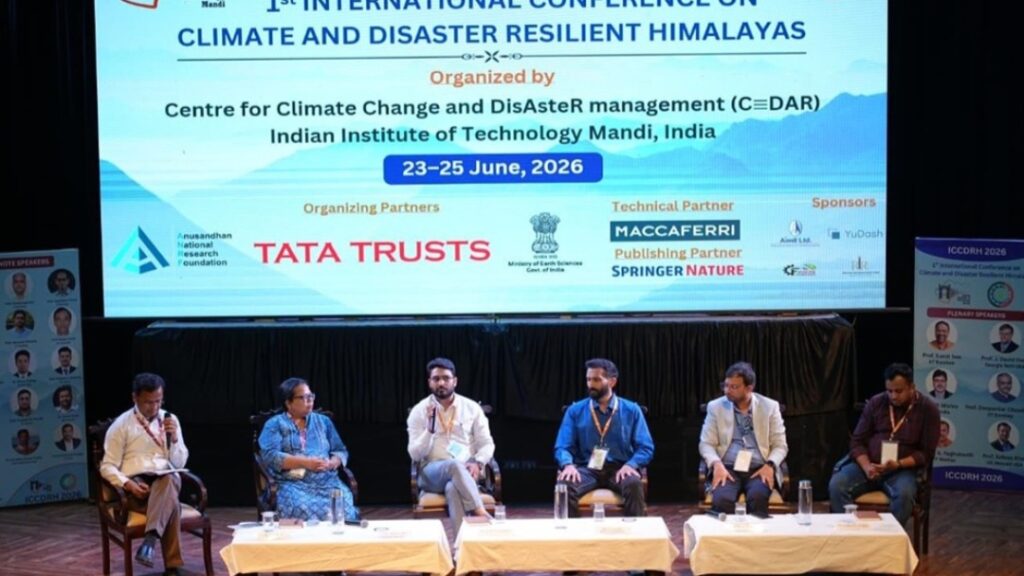
The Indian Institute of Technology (IIT) Mandi, one of India’s leading
IITs, today concluded the inaugural International Conference on Climate and Disaster Resilient
Himalayas (ICCDRH 2026), a three-day gathering held from June 23 to 25 at its Kamand campus.
Organised by the Centre for Climate Change and Disaster Management (C3DAR), the conference
brought together leading scientists, engineers, policymakers and practitioners from across the
world to confront the mounting climate and disaster challenges facing the Himalayan region.
The Himalayas rank among the planet’s most climate-sensitive and disaster-prone landscapes,
exposed to floods, cloudbursts, glacial lake outburst floods, landslides and earthquakes that
increasingly threaten mountain communities. By convening the discussion in the heart of the
Himalayas, the conference sought to bridge cutting-edge science with on-the-ground policy and
engineering for the region’s long-term resilience. The event drew a strong international and
national lineup.
Plenary addresses included Prof. J. David Frost of the Georgia Institute of Technology and Prof.
Safeeq Khan of the University of California Merced, with further plenary and keynote speakers
from premier institutions such as Imperial College London and Michigan State University,
alongside leading experts from the IITs, CSIR-NGRI, the National Institute of Hydrology, the
National Centre for Seismology and central government bodies. Sessions over the three days
spanned multihazard risk assessment, climate projections, hydrological and glacial extremes,
earthquake and infrastructure resilience, the application of artificial intelligence and machine
learning to early warning and prediction, and community-centred approaches to disaster
management.
A pre-conference workshop on disaster-resilient critical infrastructure, supported by the
Coalition for Disaster Resilient Infrastructure, preceded the main event on June 22. The
conference culminated in deliberation and recommendations aimed at strengthening climate
and disaster resilience across the Indian Himalayan Region. Experts emphasised that the
region’s challenges can no longer be addressed in isolation and called for an integrated
approach that accounts for multiple, often cascading hazards, where a single trigger such as
intense rainfall can set off floods, landslides and infrastructure failure in quick succession.
They stressed that climate change is amplifying the frequency and intensity of these events,
making a siloed, single-hazard response inadequate for the mountains. To this end, participants
recommended closer integration of science with governance, sustained investment in early
warning systems and resilient infrastructure, stronger data sharing and risk mapping across
agencies, and community-centred preparedness that places local populations at the centre of
resilience planning.
The deliberations underlined the need to translate research into actionable policy so that
scientific advances reach the villages, towns and critical lifelines most exposed to Himalayan
hazards. Held under the patronage of Prof. Laxmidhar Behera, Director, IIT Mandi, and chaired
by Prof. Kala Venkata Uday of C3DAR, the conference was coordinated by Organising Secretary
Prof. Vivek Gupta. It was supported by the Anusandhan National Research Foundation, TATA
Trusts and the Ministry of Earth Sciences, with Maccaferri as technical partner and Springer
Nature as publishing partner.