International Seminar on Tilak’s Nationalism Inaugurated at IIAS
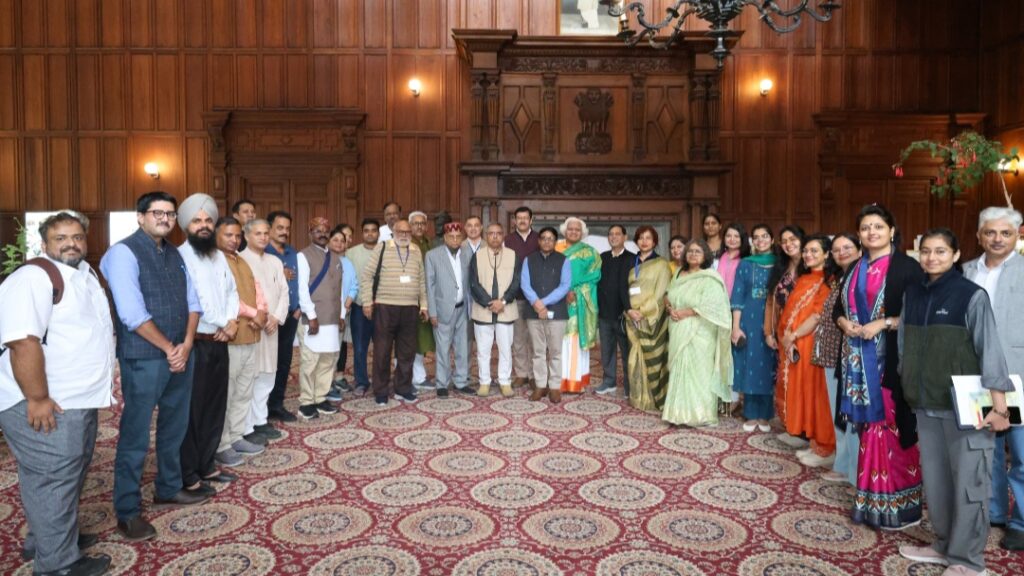
A three-day International Seminar (Hybrid Mode) on “The Role of Tilak in National Integration” commenced today at the Indian Institute of Advanced Study (IIAS), Rashtrapati Niwas, Shimla. Bringing together eminent scholars, academicians and researchers from India and abroad, the seminar aims to reinterpret the nationalist philosophy of Lokmanya Bal Gangadhar Tilak, with particular emphasis on his ideas of cultural nationalism, Karmayoga, Swaraj, Swadeshi and national integration in the contemporary context. The deliberations are centred on Tilak’s contributions to nation-building, cultural renaissance, religious pluralism and the Indian knowledge tradition.
In his welcome address, Professor Himanshu Kumar Chaturvedi, Director, IIAS, said that the Institute has consistently encouraged academic discourse that connects India’s rich intellectual traditions with contemporary issues. He observed that Lokmanya Tilak was not only a pioneer of India’s freedom movement but also a powerful advocate of India’s cultural consciousness, self-respect and national unity. His ideas, he remarked, continue to provide direction to the nation even today.
Introducing the theme of the seminar, Professor R. C. Sinha, National Fellow at IIAS and Convener of the seminar, stated that Tilak’s personality and contributions cannot be confined merely to political leadership. Through his seminal work Gita Rahasya, Tilak offered a profound interpretation of Karmayoga that provided an ideological foundation for India’s freedom struggle. He further noted that Tilak transformed India’s cultural heritage into a powerful instrument of public awakening, thereby broadening the scope of national consciousness.
Delivering the inaugural address, Professor Kuldip Chand Agnihotri, former Vice-Chancellor of the Central University of Himachal Pradesh and Executive Vice-Chairman of the Haryana Sahitya and Sanskriti Akademi, said that Lokmanya Tilak instilled self-confidence, cultural pride and national consciousness among the people of India. He emphasised that, for Tilak, Swaraj was not merely a question of political freedom but also the foundation of India’s cultural, intellectual and moral self-reliance. He observed that Tilak’s interpretation of Indian philosophy, the Bhagavad Gita and Sanatan cultural values remains highly relevant in addressing many of the challenges confronting the nation today. He also urged young scholars and researchers to undertake a serious study of the foundational sources of India’s intellectual tradition.
Presiding over the inaugural session, Professor Shashi Prabha Kumar, Chairperson of IIAS, remarked that Lokmanya Tilak’s thought is not merely a subject of historical inquiry but a guiding force for both present and future India. She observed that national integration rests not only upon political structures but also upon shared cultural consciousness, moral values and social harmony. At a time when questions of identity and culture are once again gaining prominence across the world, she said, Tilak’s ideas offer a meaningful perspective for contemporary society.
The seminar also highlighted that Tilak infused self-confidence among the people through his historic proclamation, “Swaraj is my birthright,” and transformed public celebrations such as the Ganesh Utsav and Shivaji Utsav into effective platforms for national awakening and social cohesion. His concepts of Karmayoga, Swadeshi and cultural nationalism continue to occupy a significant place in India’s intellectual and cultural journey.
During the three-day international seminar, scholars from universities and institutions in India and abroad will present research papers on a wide range of themes, including Tilak as a nationalist, cultural nationalism, religious pluralism and national integration, the concept of Swaraj, Gita Rahasya, Karmayoga, Swadeshi, the Indian knowledge tradition, and Tilak’s contribution to the making of modern India.
The inaugural session was moderated by Dr Akhilesh Pathak, Public Relations Officer, IIAS, while Shri Mehar Chand Negi, Secretary, IIAS, proposed the vote of thanks, expressing gratitude to all the distinguished guests, scholars and participants for their presence and valuable contributions.
Following the inaugural session, the seminar proceeded with its technical deliberations after the lunch break, bringing together eminent scholars from across the country to engage in rigorous academic discussions on various dimensions of Lokmanya Bal Gangadhar Tilak’s philosophy and his contribution to national integration.
The first technical session was chaired by Professor S. Panneerselvam, former Professor and Head, Department of Philosophy, University of Madras. The session commenced with a scholarly presentation by Professor Anil Kumar Prasad, Professor of English, Libya, who examined “Bal Gangadhar Tilak: Nationalism, Cultural Resistance, and the Discourse of Decolonization,” highlighting Tilak’s vision of cultural resurgence as a powerful response to colonial domination. This was followed by an illuminating presentation by Professor D. N. Tiwari, former Professor and Head, Department of Philosophy and Religion, Banaras Hindu University, who critically analysed Tilak’s responses to the critics of the doctrine of Niṣkāma Karma in the Bhagavad Gita, demonstrating the philosophical depth of Tilak’s interpretation in Gita Rahasya.
The second technical session was chaired by Professor Jata Shankar Tiwari, former Professor and Head, Department of Philosophy, University of Allahabad. The first presentation was delivered by Professor Veenu Pant, Department of History, Sikkim University, who explored the philosophical foundations of geo-cultural nationalism through Tilak’s seminal work Gita Rahasya. The second paper was presented by Professor Dwarka Nath, Yogiraj Gambhir Nath UGC Chair Professor, Deen Dayal Upadhyaya Gorakhpur University, who offered a detailed exposition of the concept of Lokasangraha as articulated by Tilak in Gita Rahasya, emphasising its continuing relevance to social responsibility and national integration.
The third technical session, chaired by Professor Sudhir Kumar Arya, Professor, School of Sanskrit and Indic Studies, Jawaharlal Nehru University, featured two distinguished presentations. Professor Uma C. Vaidya, Tagore Fellow at the Indian Institute of Advanced Study, presented a critical study of Tilak’s celebrated work The Arctic Home in the Vedas, revisiting its intellectual and historical significance. This was followed by Professor (Dr.) Ramnath Pandey of The Maharaja Sayajirao University of Baroda, whose paper, “Lokmanya Tilak and Indigenous Aryanism: Reclaiming Cultural Identity for National Integration,” examined Tilak’s contribution to the discourse on indigenous identity and cultural self-assertion in the context of national integration.
The deliberations across all three technical sessions generated engaging academic discussions and highlighted the enduring relevance of Lokmanya Bal Gangadhar Tilak’s ideas on Swaraj, Karmayoga, cultural nationalism, civilisational consciousness, and national integration, setting a strong intellectual foundation for the subsequent sessions of the three-day international seminar.