How Mandi’s Women & Youth Are Turning Barren Hills Green – And Building Their Own Lives Around It
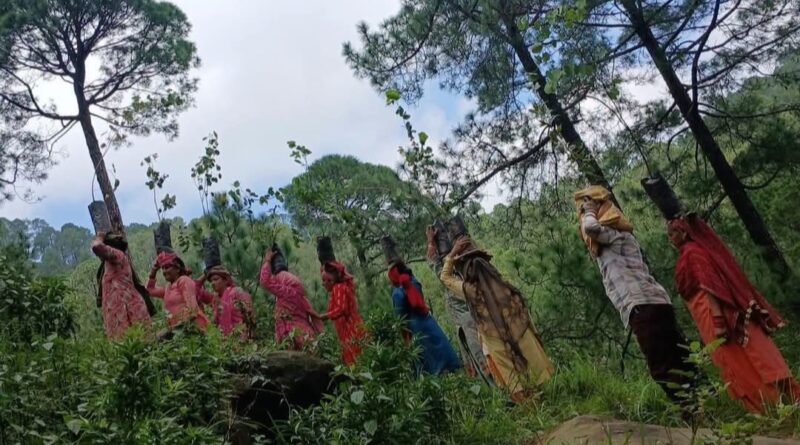
For years, the women of Saletar village would wake up to the same dry, dusty hillsides, watching their children leave for cities in search of work. Today, those same hills are dotted with fresh green saplings – and the women are no longer just watching. They’re planting, nurturing, and earning.
This isn’t a government brochure. It’s the sound of a quiet revolution, powered by the Rajiv Gandhi Forest Conservation Scheme – and it’s putting the power back into the hands of those who know the land best: local women and young people.
Take Bhupendra Kumar, a young man from Shandla. He used to worry about his future in a village with few opportunities. Now, as president of the Ekta Youth Group, he leads a team that has planted thousands of trees – and he beams with pride. “This isn’t just about trees,” he says, his voice cracking with emotion. “It’s about our self-respect. The Chief Minister has given us a chance to be part of something bigger than ourselves.”
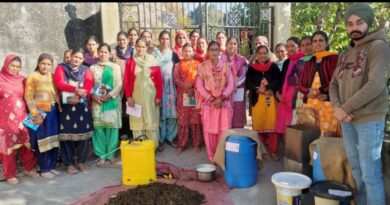
And the numbers tell a story too. In Mandi Forest Division alone, 8 women’s groups and 2 youth groups have planted 16,000 saplings across 20 hectares this year – with each group receiving ₹1.20 lakh per hectare to care for the plants. For women like Nanda Kumari, president of the Saletar Women’s Group, that money means more than just income. “We used to depend on our husbands for every rupee,” she says, smiling as she waters a young amla sapling. “Now we have our own bank balance – and our own forest.”
The forest department didn’t just hand over saplings and walk away. They worked with the community to choose local, useful species – deodar, shisham, jamun, amla, behda, and more – that will give fruit, fuel, and shade for generations. “We planted with science, not guesswork,” says a local forest officer, pointing to the micro-plans that guided every pit and every watering schedule.
But what makes this scheme truly special is the feeling of ownership. These aren’t government trees – they’re their trees. Women like Garima, who leads the Siddhi Vinayak group, now check on their plots like proud mothers. “If a sapling wilts, we feel it in our hearts,” she admits. “We stay up at night thinking about how to protect them from stray cattle.” And it’s working – survival rates are soaring.
Across the entire Mandi Forest Circle, the scheme has approved work on 121.5 hectares, with over ₹1.24 crore already flowing into local hands. More than 74 groups have received 1.22 lakh saplings, and over ₹1 crore has been spent directly on the ground – not in distant offices, but in the pockets of rural families.
For Shakuntala Devi, president of the Lakshmi Women’s Group in Siun, this is a lifeline. “My husband is a daily-wage labourer. When work dries up, we go hungry. Now, even in the off-season, I earn from tending our plantation. My children can afford notebooks.” Her eyes glisten as she adds, “And when they grow up, they’ll see these trees and remember – their mother helped build this forest.”
The youth, too, have found a new calling. Dushyant Thakur, who leads the Nehru Youth Group in Riyur, used to spend his evenings idle. Now he’s a self-appointed guardian of over a hundred saplings. “We’re not just planting trees – we’re planting our future,” he says. “Every leaf that unfurls is a promise that our village won’t be abandoned.”
Chief Minister Thakur Sukhvinder Singh Sukhu, who has personally championed the scheme, received heartfelt thanks from every group. “He didn’t just give us orders; he gave us trust,” says Ram Prakash of the Darunal Youth Group. “That trust is what makes us work like our own land depends on it – because it does.”
This isn’t a one-off campaign. It’s a movement. The scheme is quietly weaving together environmental protection, climate resilience, and rural livelihoods into a single, human thread. It’s about a grandmother teaching her granddaughter which leaf heals a wound. It’s about a young man choosing to stay back in his village because he sees a future there. It’s about hills that were once brown now turning a hopeful green – and the faces of the people tending them, glowing with dignity.
As the sun sets over the new plantations of Mandi, you can hear the laughter of women returning home, their hands calloused but their hearts full. They know that every sapling they’ve put in the ground is a stake in their own destiny. And in that simple act, they are shaping not just a greener Himachal, but a fairer, more hopeful one.
This is not just a government scheme. This is the story of people who refused to wait for change – and went out and planted it themselves.