Three-Day International Seminar on Indian Knowledge Tradition and Classical Arts Concludes at IIAS
The three-day International Seminar and Performance Series titled “Abhijātakalākalāpeṣu Bhāratīya-Jñāna-Paramparā (Sadyovṛttāntaḥ): Tracing Roots of Bhāratīya Jñāna Paramparā in Contemporary Practice of Classical Arts” concluded successfully today at the Indian Institute of Advanced Study (IIAS), Rashtrapati Nivas, Shimla. Organized from May 21 to 23, 2026, the seminar brought together eminent scholars, artists, researchers, and practitioners from India and abroad to engage in extensive deliberations on Indian Knowledge Tradition, classical arts, aesthetics, dramaturgy, spirituality, cultural history, and contemporary intellectual discourses.
Over the course of three days, the seminar attempted to understand Indian artistic traditions not merely as forms of performance or cultural activity, but as important foundations of the Indian Knowledge System, philosophical thought, collective memory, and spiritual experience. Across various sessions, a significant consensus emerged that Indian classical arts have historically served as carriers of civilizational continuity, cultural consciousness, and human sensitivity, and that their aesthetic and philosophical foundations continue to hold relevance in contemporary society.
Detailed discussions were held on themes related to Natyashastra, Rasa theory, Sanskrit theatre, Bhakti traditions, Indian classical dance forms, yoga, music, architecture, sculpture, aesthetics, Devadasi traditions, the National Education Policy, and the Indian Knowledge Tradition in the context of Artificial Intelligence. Scholars emphasized that in the Indian tradition, art, philosophy, spirituality, and everyday life have always remained deeply interconnected, and that understanding them in isolation does not do justice to the integral spirit of Indian civilization.
The seminar also highlighted the challenges confronting Indian classical arts in an era marked by globalization, digital media, and rapidly changing cultural trends. Speakers stressed that the need to meaningfully communicate the guru-shishya parampara, classical discipline, cultural values, and Indian aesthetic consciousness to younger generations has become more urgent than ever before. Several participants observed that integrating the Indian Knowledge System with contemporary education, research, and cultural discourse is an important necessity of the present time.
The seminar witnessed participation from distinguished scholars and artists associated with leading national and international institutions. Prof. Mahesh Champaklal spoke on the Natyashastric tradition of Sanskrit theatre, while Padma Bhushan awardee Dr. R. Ganesh elaborated upon the aesthetic journey from Rasa to Rasika within Indian poetic and performative traditions. Guru Shama Bhate reflected upon the evolution of Kathak, while Prof. Choodamani Nandagopal highlighted the interrelationship between Indian dance, architecture, painting, and sculpture. Dr. Swarnamalaya Ganesh, Dr. Anupama Kylash, Shri Vaibhav Arekar, Prof. Ashish Khokar, Prof. Meenakshi Iyer Gangopadhyay, and several other eminent scholars and performers delivered lectures and demonstrations on diverse dimensions of Indian artistic traditions.
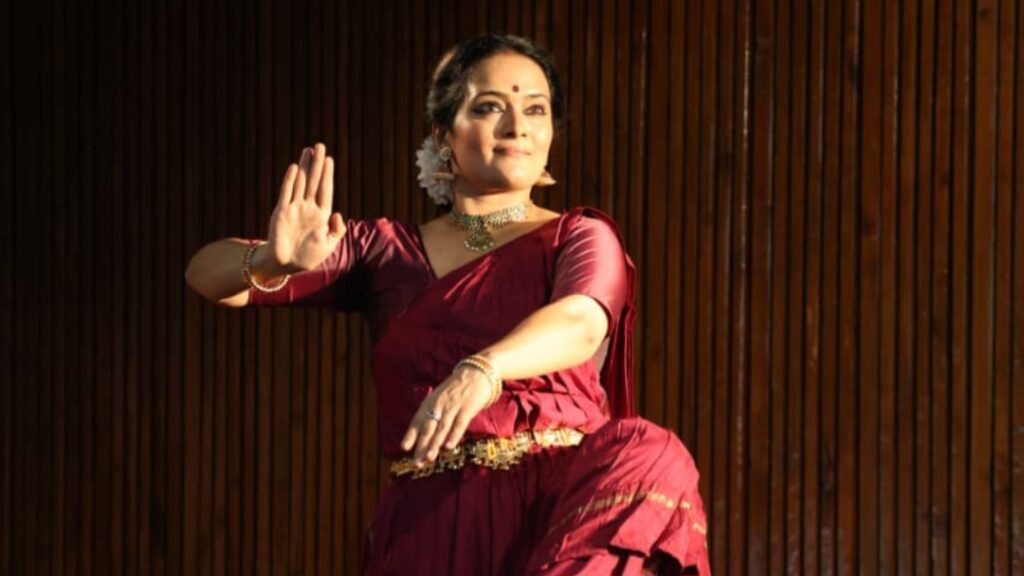
The performance series organized as part of the seminar offered audiences profound experiences of Indian aesthetics, spirituality, and cultural consciousness through presentations in classical dance and music. Performances such as Anushthana Chakra Alaripu, Nrityollasa, Gītagovindam, Gandhigita, Nāda–Rasa–Vimarśa, and Sat-Cit-Anand received special appreciation from the participants and audience alike.
During the valedictory session, a Prashasti composed by Prof. Uma Vaidya was recited by Dr. Mansi, Fellow of the Institute. Presenting the seminar report, the Convener, Dr. Uma Anantani, observed that the seminar had opened new directions for serious academic discourse on the interconnections between Indian Knowledge Tradition and classical arts. She stated that the seminar attempted to re-establish the intrinsic relationship between artistic practice and knowledge traditions in a contemporary context.
Addressing the valedictory session as the Chief Guest, historian and Additional Commissioner of Income Tax Dr. Rashmita Jha remarked that culture is not a static product or a museum artifact, but a living and continuously evolving process shaped by the collective consciousness, memories, experiences, and values of society. She stated that the greatest strength of Indian civilization lies in its cultural continuity and its remarkable capacity for assimilation, which has enabled Indian artistic traditions to preserve their essential spirit despite changes in time, society, and historical circumstances. She emphasized that the preservation of the Indian Knowledge Tradition cannot be achieved solely through archives and texts, but through living cultural practices, performative traditions, and active social participation.
In the valedictory lecture, Dr. Bhagyesh Vasudev Jha, Chairman of the Gujarat Sahitya Academy and eminent scholar, reflected upon the broader dimensions of Indian cultural traditions, knowledge practices, and civilizational thought. He stated that the foundation of the Indian Knowledge Tradition lies not merely in external achievements, but in inner refinement, self-discipline, and the development of consciousness. He observed that Indian art, literature, and philosophy have historically nurtured values of balance, compassion, and coexistence within society. He further remarked that Indian classical arts are not merely stage performances, but expressions of a comprehensive life-view integrating spirituality, sensitivity, and lived cultural experience.
In his presidential remarks, Prof. Himanshu Kumar Chaturvedi, Director, IIAS, stated that a comprehensive understanding of the Indian Knowledge System requires renewed attention to the interconnections between art, literature, philosophy, history, and spirituality. He observed that Indian traditions have never viewed knowledge in fragmented terms, but have sought to understand life and society through an integrated perspective. He further stated that the Indian Institute of Advanced Study would continue to promote serious study, dialogue, and reinterpretation of India’s intellectual, cultural, and philosophical traditions through such academic initiatives.
The programme concluded with the presentation “Sat-Cit-Anand” by young participants, followed by Vande Mataram and the National Anthem. The vote of thanks was delivered by Dr. Rajeev Kumar Mishra, Librarian and Incharge (ARO), IIAS.