NIT Rourkela Secures Patent for Fast and Accurate Spice Adulteration Analysis
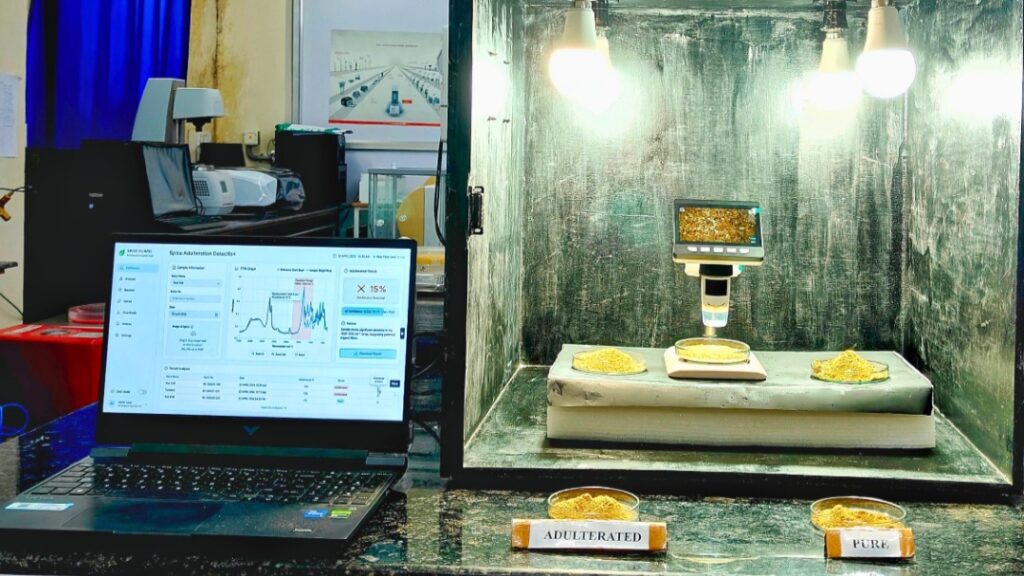
NIT Rourkela researchers have secured a patent for a system capable of rapidly detecting and measuring adulteration in spices and other food products. Addressing the global food safety challenge, the developed technology combines Fourier Transform Infrared (FTIR) spectroscopy with advanced machine learning models to deliver accurate results.
In Indian context, food and spice adulteration poses a serious health and economic risks. It is often driven by cost-cutting practices and inadequate food safety standard checks. Traditional food adulteration detection methods such as chromatography, or molecular techniques, are resource-intensive and take large amount of time to deliver results, making them less suitable for rapid, routine testing.
To address these limitations, the system developed by NIT Rourkela researchers provide a rapid, non-destructive, and cost-effective alternative suitable for real-time deployment in quality control laboratories and industrial processing units.
FTIR spectroscopy is a technique used to identify organic, and some inorganic materials by measuring how they absorb infrared light. During food checks, the developed system collects these patterns and processes them using machine learning models. These models look at complex, non-linear patterns in the sample to detect abnormalities and give accurate results on adulteration levels.
Unlike conventional methods that only show whether the food product is adulterated or not, the developed technology measures the level of adulteration of food within seconds. This capability is essential for food processing industries and regulatory bodies that require precise measurements to ensure compliance and maintain product quality.
Published in the prestigious Food Chemistry journal, the research has been conducted by Prof. Sushil Kumar Singh (Assistant Professor), Late Prof. Poonam Singha, and M. Tech. graduate Mr. Rishabh Goyal from the Department of Food Process Engineering, NIT Rourkela. The research team has also secured a patent titled “Method and System for Detecting and Quantifying Adulteration in Food Stuff” for the developed technology (Patent number: 581403; Application number: 202431050538).
Speaking about the research, Prof. Sushil Kumar Singh, Assistant Professor, Department of Food Process Engineering, NIT Rourkela, said, “Our invention focuses on addressing a long-standing challenge in food industry, which is absence of a fast and reliable spice adulteration detection system. We have combined existing rapid detection equipment with novel machine learning approaches to develop an integrated system with effective decision-making capability. This innovation will not only ensure food safety and regulatory compliance but also strengthen consumer trust across the supply chain. I believe this invention holds great potential for the food industry, particularly in the Indian market.”
Study on detecting coriander powder adulteration
Beyond the initial validation of the developed system, the research team also addressed a common and concerning adulteration practice, the mixing of sawdust in coriander powder. By applying machine learning models integrated with FTIR spectroscopy, the team developed a framework capable of analysing and detecting adulteration with around 92% accuracy.
In addition to validating the system’s effectiveness for coriander adulteration, the published research also establishes a methodological pathway for detecting multiple types of adulterants across various food products.
Speaking about the real-world application of the developed system, Prof. Sushil Kumar Singh added, “Any food company that processes spice at any stage, from raw materials to finished products, requires rapid adulteration detection. Our developed system can seamlessly integrate into their existing quality control workflows and allow real time decision making, which is highly suitable for routine screening. With its scalability and cost-effectiveness, the system has strong potential for adoption by both large industries and SMEs.”
In comparison, conventional methods are laboratory based and require extensive manpower and chemical reagents to detect the adulteration. This results in significantly higher operational cost. The system developed by NIT Rourkela team reduces production delays by eliminating the need for complex sample preparation and longer analysis time. This cost advantage is relevant for price-sensitive markets, such as India, where large scale screening and affordable food safety solutions are critically needed.
As next step, the research team aims to collaborate with industry partners for conducting pilot-scale studies and validating the system under real-world conditions. Additionally, they plan to conduct experiments under different conditions to extend its detection capability beyond spices.
As concerns around food safety continue to rise, innovations like this are expected to play a key role in enhancing accountability, and public health across the food supply chain.