Rising Flames in the Himalayas: CSIR‑IHBT Study Warns of Changing Forest Fire Patterns
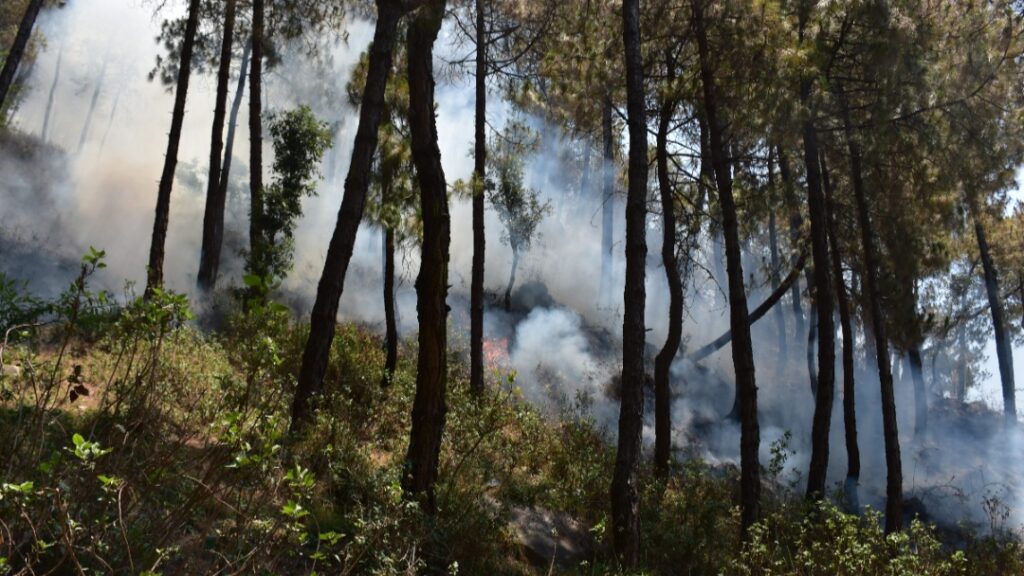
A comprehensive new study by scientists at the CSIR–Institute of Himalayan Bioresource Technology (CSIR‑IHBT) has raised fresh concerns about the growing threat of forest fires across the Western Himalayas. By analysing nearly 20 years of satellite data, the researchers have found not only that forest fires are becoming more frequent, but also that they are steadily moving towards higher altitudes—a trend closely linked to changing climate conditions.
The study, led by Dr Amit Kumar along with his student Dr Sunil Kumar, reveals that the Western Himalayan region records an average of around 1,300 forest fire incidents every year. What is particularly alarming is the gradual upward shift of these fires into higher elevations, once considered relatively safe from such disturbances.
According to the research, the forest fire season typically stretches from February to June, with May emerging as the most critical month. High temperatures combined with prolonged dry conditions during this period create ideal conditions for fires to spread rapidly. A month-wise analysis shows a clear geographical progression: the fire season begins in February in Uttarakhand, moves to Himachal Pradesh in March, reaches Jammu & Kashmir by April, and peaks in Ladakh by May.
While forest fires are often attributed to human activities, the study highlights that weather conditions play a decisive role in determining how serious and widespread these fires become. Rising temperatures and extended dry spells significantly increase fire intensity and spread. Among different forest types, Chir pine-dominated ecosystems were found to be the most vulnerable, accounting for 57 per cent of fire incidents. These were followed by deciduous broadleaf forests (24 per cent) and shrublands.
Region-wise, Uttarakhand emerged as the most fire-prone state in the Western Himalayas, followed by Himachal Pradesh, Jammu & Kashmir, and Ladakh. Interestingly, the researchers noted that even though forest cover has increased across Himalayan states, the resulting higher biomass—combined with increasing human pressure—may actually be contributing to more frequent fires, especially in Uttarakhand.
One of the most important findings of the study is that land surface temperature has a stronger influence on forest fire occurrence than rainfall, underlining the growing impact of climate warming on fire risk. This clearly indicates that forest fire activity is not only increasing in intensity but is also expanding into new, higher-elevation zones.
Using advanced Remote Sensing and GIS techniques, the CSIR‑IHBT team mapped fire hotspots and analysed fire frequency and intensity across the region. A focused case study in Himachal Pradesh’s Kangra region revealed that over 50 per cent of forest areas are vulnerable to fires, with nearly 10 per cent classified as high-risk zones. The presence of thousands of villages within fire-sensitive areas has raised serious concerns about threats to biodiversity, forest health and local livelihoods.
The researchers say their findings can play a crucial role in strengthening early warning systems, fire risk assessment and forest management planning, helping authorities respond more effectively to fire threats while supporting biodiversity conservation and climate resilience.
To further strengthen research in this area, CSIR‑IHBT has also installed a PhenoMet system at the Baba Balaknath Temple site in a fire-prone Chir pine forest. This automated system combines a time-lapse camera with a weather station to continuously monitor temperature, humidity, rainfall, solar radiation and seasonal vegetation changes. By detecting warning signs such as rising temperatures and prolonged dryness, the system helps assess fire risk and support timely early warnings.
Emphasising the importance of this work, CSIR‑IHBT Director Dr Sudesh Kumar Yadav said that forest fire patterns in the Himalayas are evolving rapidly and are closely linked to rising temperatures. He stressed the need for stronger early warning mechanisms and more advanced Remote Sensing and GIS-based forest management, including the use of drone-enabled thermal and multispectral monitoring supported by ground data.
The initiative reflects CSIR‑IHBT’s continued commitment to addressing critical environmental challenges through science-driven solutions, providing vital insights for the sustainable management and long-term protection of fragile Himalayan ecosystems.