Self-Reliance Must Be Anchored in National Confidence and Global Cooperation
Governor Addresses Valedictory Session of Two-Day National Seminar at IIAS, Shimla
Calls for a Balanced Approach Combining Tradition, Technology, Innovation and Human Values
Governor Shri Kavinder Gupta today said that the journey from Swaraj and Swadeshi to Atmanirbhar Bharat represents a continuing national endeavour towards self-confidence, self-reliance and inclusive development.
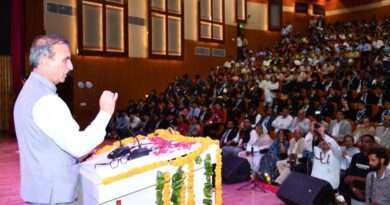
Addressing the valedictory session of a two-day national seminar at the Indian Institute of Advanced Study (IIAS), Shimla, the Governor said that the theme of the seminar was not merely an academic subject but was closely linked with India’s development journey, civilisational consciousness, social and economic aspirations and the vision for the future.
The Governor said that self-reliance should not mean isolation from the world. India must strengthen its own capabilities while remaining open to global knowledge, science, technology, trade and cooperation. He highlighted the relevance of Pandit Deendayal Upadhyaya’s philosophy of Integral Humanism and Antyodaya, which places the holistic development of the individual and the welfare of the last person at the centre of development.
Shri Kavinder Gupta said that meaningful development must go beyond production and consumption and encompass human dignity, social harmony, ethics, cultural values, environmental balance and the welfare of every section of society.
He said that women, farmers, artisans, workers, entrepreneurs, tribal communities, rural populations, youth and persons with disabilities must have equal opportunities to participate in the development process. Local economies, traditional knowledge, handicrafts and small enterprises should also be strengthened as important pillars of self-reliance.
Referring to Viksit Bharat-2047, the Governor said that the vision of a developed India requires collective participation and a spirit of Sabka Prayas. He said that self-reliance was not merely an economic or technological objective, but also a commitment to national confidence and collective capacity building.
The Governor said that India’s strength lies in the ability to harmonise tradition and modernity. “Our tradition can provide values, science can provide tools, democracy can provide institutions and our youth can provide energy. Their integration can give a new direction to the India of the future,” he said.
Emphasising the need for responsible development, he said that progress must be accompanied by responsibility, technology by ethics, prosperity by sensitivity and self-reliance by self-restraint.
He urged scholars and research institutions to undertake critical and academic study of India’s development model and civilisational thought, while encouraging new questions, research and intellectual dialogue.
Shri Kavinder Gupta expressed confidence that the seminar would go beyond a two-day academic event and contribute to a sustained intellectual dialogue on India’s development, self-reliance and civilisational perspective.
The Governor released books including, “Dalit Movement in North India: Theory, Practice, and Challenges”, “Decolonizing Cannabis: History, Hegemony and Opportunities (with a special focus on the Himalayas)”, “Folk and Rural Imagery in Kangra Miniatures: An Indigenous Indian Art Perspective”, “27th RKML “Humanity as the Heart and Honey of All Living Beings: The Idealistic” and “Realism of Bṛhadāraṇyaka Upanishad” on the occasion.
Dr. Vinay Sahasrabuddhe, President, Asiatic Society, Mumbai shared his views on current challenges, problems, and their solutions through virtual mode.
Earlier, Director, IIAS, Prof. Himanshu Kumar Chaturvedi welcomed and honoured the Governor and Lady Governor Smt. Bindu Gupta and briefied about the two days National Seminar on “The Quest for Atmanirbhar Bharat: From the Past, through the Present, to the Future”.
Shri Prafulla Ketkar, Editor, Organiser also spoke on the occasion.
Programme Coordinator Dr. Ayushi Ketkar presented a report on the Seminar.
Dr. Rajiv Kumar Mishra, Librarian, IIAS, proposed a vote of thanks.
-0-