The Highly Hazardous Pesticide Crisis: Why Himachal Needs an Agrochemical Reset
This article has been authored by Guman Singh, Coordinator, Himalaya NITI Abhiyan, and Satya Sainath, Agricultural Researcher
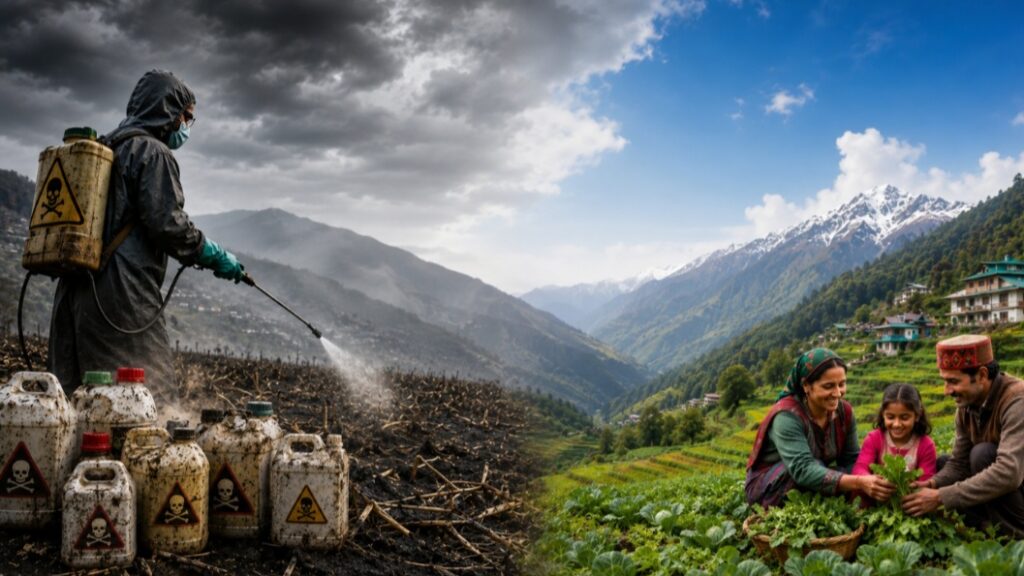
On World Environment Day, it is time to confront the growing risks that Highly Hazardous Pesticides pose to Himachal Pradesh’s farmers, water resources, biodiversity and fragile Himalayan ecosystems. Every year on World Environment Day, we celebrate the pristine ecosystems and vital watersheds of the Himalayas. Himachal Pradesh, widely regarded as Indias fruit bowl, is central to this ecological imagination. Yet, behind the sprawling apple orchards of Shimla, Kullu, Kinnaur and the lush vegetable belts of Solan and other parts of the state lies a profound, largely unacknowledged crisis. Driven by intensive, high-value horticulture, the state has developed an unregulated reliance on Highly Hazardous Pesticides (HHPs), and both its people and its environment are paying a heavy price.
The gravity of the HHP crisis in Himachal Pradesh is distinct from the agrarian struggles of other states. The cultivation of high-value cash crops like apples, and off-season vegetables, alongside the practice of clearing commons and forest land with herbicides to cultivate monsoon season peas, demands intense HHPs use. In conversations with apple farmers across Shimla and Kullu, some reports applying chemical sprays a dozen or more times in a single season. Because of this sheer frequency of application, the occupational exposure faced by Himachals landscape is exceptionally high.
The first casualty of this intensive HHPs cycle is the farmer. Epidemiological studies from Kullu and Shimla reveal the quiet suffering that has been normalized as the price of cultivation. A vast majority of farmers endure extreme fatigue, severe eye irritation, dermal lesions, and acute systemic toxicity as routine, post-spray realities of these HHPs.
What begins as an occupational hazard quickly compounds into a state-wide public health emergency. Himachal Pradesh now records the second-highest cancer incidence in India, with a mortality rate of 9.5% compared to the national average of 7.7%. More alarming than the numbers themselves is their trajectory: the annual growth rate of cancer cases in Himachal has reached 2.2 percent, far outpacing the national rate of 0.6 percent. The state is not moving with the national trend; it is accelerating past it.
In the state assembly, Chief Minister Sukhvinder Singh Sukhu publicly attributed this alarming surge to the excessive use of pesticides and chemical fertilizers. The medical fraternity has echoed the concern. Leading oncologists of Himachal Pradesh, has publicly called for a regulatory law, and agricultural pesticides posing a grave concern to the state public health. IGMC and Himachal Pradesh University are now conducting joint research to quantify the extent of this contamination.
Pesticide poisoning through contaminated water, soil, or food is often linked to the widespread use of chemical pesticides in Indian agriculture. While many studies have reported the association between HHPs exposure and human health impacts, it has been challenging to disseminate this information to a broader population at state and national levels.
Paraquat has become a symbol of the global debate around Highly Hazardous Pesticides. The herbicide has been banned or severely restricted in more than 75 countries because of concerns regarding human health, environmental contamination and occupational exposure. In a significant development, Syngenta, the original manufacturer of paraquat, has announced the cessation of its global production. Yet the chemical remains available in several agricultural regions, highlighting the need for a closer review of its continued role in Himachal Pradesh’s farming systems. In Shimla division of Himachal Pradesh, forensic records documented 585 deaths linked to agricultural pesticides and phosphine compounds over five years. International evidence from countries that have phased out the most toxic pesticides shows substantial reductions in pesticide-related mortality, without losses in agricultural output.
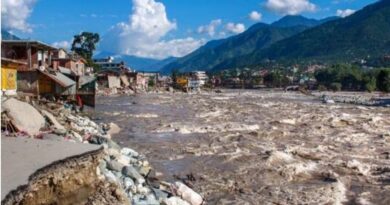
This devastation does not end at the hospital doors. It is quietly unravelling the environment. As the “water tower” of North India, Himachals ecosystem is uniquely sensitive. Peak pesticide application in the state coincides directly with the heavy rainfall patterns. Rains aggressively wash toxic chemical loads off farms and into local mountain streams (khuds).
Beneath the soil, the living foundation of agriculture is being sterilised. Routine drenching with systemic HHPs reduces beneficial soil microbial diversity by up to 60%. When natural nitrogen-fixing bacteria are eradicated, soil fertility crashes. This forces farmers into an expensive and vicious “fertilizer trap,” compelling them to buy more synthetic inputs every year just to maintain baseline yields.
Above ground, the ecological fallout is entirely visible. Himachal Pradeshs apple economy relies heavily on insect pollination. Yet, the indiscriminate use of HHPs is driving a massive collapse of local bee populations. To salvage their harvests, farmers are now forced to rent commercial bee boxes at exorbitant costsa human-made ecological tax on a once self-sustaining ecosystem.
The growing body of evidence from public health, toxicology and environmental research points in the same direction, highly hazardous pesticides pose risks that cannot be effectively managed through safe-use instructions alone.
The immediate strategy for Himachal Pradesh must be a strict, state-led regulatory reset. This begins with banning and phasing out the most lethal HHPs, particularly those with no known antidotes or high persistence in ecosystem. Removing these HHPs from circulation causes immediate, drastic reductions in rural mortality and ecological damage without harming agricultural output.
However, a ban is only half the solution. A sustainable strategy requires equipping farmers with viable, long-term alternatives. The state must actively support the transition toward resilient horticultural crops that inherently require fewer chemicals. It must scale up Integrated Pest Management (IPM) to replace blanket chemical spraying with sustainable alternatives. Most importantly, this agrochemical phase-out must be seamlessly integrated with Himachal Pradeshs own visionary natural farming initiative, the Prakritik Kheti Khushhal Kisan Yojana (PK3Y). But a natural farming transition cannot take root in soil already contaminated with HHP residues, or in an ecosystem where the pollinators required for the state’s own fruit crops are being systematically eliminated. Phasing out Highly Hazardous Pesticides is not a constraint on that mission. It is the precondition for it.
On World Environment Day, it is worth stating plainly what the evidence from Himachal Pradesh’s own hospitals, forensic labs, and agricultural research institutions has been pointing toward: the chemicals that are poisoning the state’s farmers are the same chemicals entering its rivers, degrading its soils, and destroying the biodiversity the state depends on. This is one crisis, not several, and it requires a clear, evidence-backed regulatory response.
The future of Himachal’s agriculture depends not only on what grows in its orchards, but on the health of the farmers, rivers, soils and biodiversity that sustain them. Protecting them all requires confronting the challenge of highly hazardous pesticides.