Rethinking India’s Cities: A Thought-Provoking New Book Questions the Urban Dream
At a time when India’s cities are rapidly expanding, a new book is inviting readers to pause and reflect on what this growth really means. City Limits – The Crisis of Urbanization, part of the Rethinking India series and edited by Tikender Panwar, brings together a range of voices to examine the challenges shaping urban India today.
Rather than celebrating cities simply as engines of economic growth, the book takes a deeper and more critical look at what has been happening since the 1990s. Through a collection of essays by leading thinkers, policy experts, and practitioners, it explores how the rise of market-driven urban development has led to increasing inequality, social exclusion, and environmental stress.
At its core, City Limits questions the dominant narrative that paints urban expansion as an unquestioned success. The contributors argue that the shift towards neoliberal economic policies and reduced state welfare has created cities that are often neither inclusive nor sustainable. Instead of benefiting all, urban growth has, in many cases, widened the gap between the privileged and the marginalized.
One of the key ideas explored in the book is the “right to the city”—a powerful concept that calls for citizens to have a greater say in how urban spaces are designed, governed, and used. The essays collectively push for a reimagining of cities as shared public spaces that serve people, rather than as hubs driven mainly by corporate or technological interests.
The book also shines a light on pressing issues such as migration, homelessness, and gaps in housing policies. It highlights how many urban challenges are not accidental but are deeply rooted in the way cities are planned and managed. It raises important questions about popular initiatives like “smart cities,” suggesting that while they promise efficiency, they may overlook deeper social realities.
What makes the book particularly engaging is the diversity of voices it brings together. Contributors include Congress leader Ajay Maken, renowned architect Romi Khosla, and legal expert Mathew Idiculla, among others. Their insights add depth to the discussion, blending political, social, and environmental perspectives.
Ultimately, City Limits presents the city as a space of both conflict and possibility—a place where systems of power operate, but also where resistance and change can emerge. It serves as both a critique of current urban trends and a call to action for more equitable, sustainable, and democratic city-making.
Sukhu Unveils Tikender Panwar’s Book City Limits, Warns of Rising Cloudburst Risks
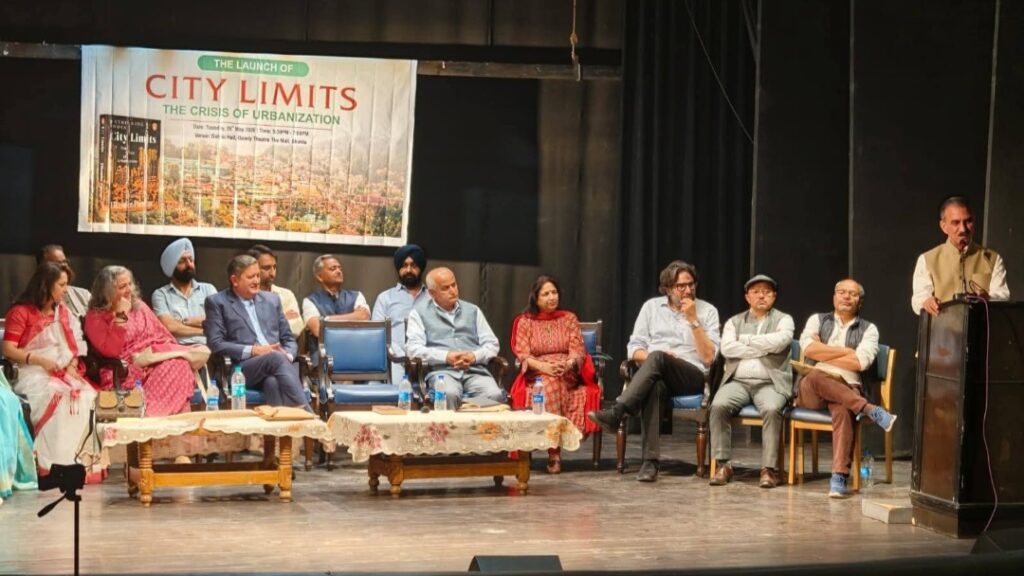
Chief Minister Thakur Sukhvinder Singh Sukhu on Tuesday evening released a book ‘City Limits – The Crisis of Urbanisation’ edited by former Deputy Mayor of Municipal Corporation Shimla Tikender Panwar at Gaiety Theatre, Shimla.
Addressing the gathering, the Chief Minister said that the nature has blessed Himachal Pradesh with clean air and water, and preserving these resources is the collective responsibility of every citizen. He said that Shimla, being the Capital and largest city of the State, has witnessed rapid transformation over the years. “I have seen Shimla changing since my childhood. Areas that once had forests are now covered with buildings. There is a need for vertical construction here,” he remarked.
The Chief Minister said that the state government is constructing an underground duct system in Shimla at a cost of Rs. 145 crore to remove overhead wiring and improve the city’s aesthetics. He added that a new modern complex is being developed at the present Sabzi Mandi area with an investment of Rs. 600 crore. An underpass near the Lift area has also been proposed. He further said that Rs. 800 crore water supply scheme is being implemented to ensure 24-hour water availability in Shimla town. In addition, land acquisition work is underway for widening the Circular Road, while efforts are also being made to increase notified green areas in order to preserve the beauty of the city.
Highlighting the State Government’s focus on sustainable development, the Chief Minister said several projects are being undertaken for the beautification of the capital city while maintaining environmental balance. He also stated that new townships such as Him-Chandigarh, Him-Panchkula and an Aero City in Kangra are being planned. Infrastructure related to tourism is also being strengthened, he added.
Emphasising on sustainable development, the Chief Minister said that Himachal Pradesh has faced two major natural disasters in the last three years, causing extensive damage in the State. He said that cloudburst incidents are now being scientifically studied, as such events are no longer confined to higher reaches but are also occurring in lower areas. He cited incidents in parts of the Seraj Assembly constituency as evidence of this trend.
The Chief Minister said: “During a meeting with the Union Home Minister, I mentioned that cloudburst incidents will not remain limited to Himachal Pradesh in the future. Such incidents are likely to increase in Uttarakhand and the Northeastern States as well.” He reiterated that the state government was committed to taking Himachal Pradesh forward on the path of development while safeguarding the State’s natural environment, culture and social balance.
Former Chief Justice of the Jharkhand High Court Justice Tarlok Singh Chauhan, while addressing the gathering, said that people need to improve their own conduct before blaming others. Referring to tourism-related concerns, he said that restrictions should not only be imposed on tourists, but citizens must also act responsibly. He stated that many people are purchasing multiple vehicles despite having no parking facilities. He further remarked that during school hours, the majority of traffic congestion is caused not by tourists’ vehicles, but mainly by Himachal-registered vehicles. “We need to introspect,” he said.
Justice Chauhan said: “The main issue I want to discuss is that the State requires complete institutional accountability. Urbanization is not merely a demographic change, it is the reorganization of society itself. Millions of people are entering public life, sharing common resources and depending on urban local bodies and planning frameworks. However, our institutions are not keeping pace with this transformation. The people who ultimately pay the price for this institutional failure are invariably those who are the least powerful.”
Mayor Municipal Corporation Shimla Surinder Chauhan, Principal Media Advisor to the Chief Minister Naresh Chauhan, Education Secretary Rakesh Kanwar, Director General Home Guards Satwant Atwal, former Deputy Mayor Tikender Panwar Municipal Corporation Shimla and Bureau Chief of the Tribune Pratibha Chauhan, along with other dignitaries were present on the occasion.
About the Editor
Tikender Panwar, who has edited the volume, brings significant experience to the subject. A former Deputy Mayor of Shimla, he has been closely involved in urban governance and sustainability initiatives. He is also a regular commentator on issues related to development, tourism, and the Himalayan ecosystem, and has authored several books on urbanization.
With contributions from a wide range of experts and published by Penguin Vintage, City Limits offers readers an insightful and timely exploration of India’s urban future—one that challenges assumptions and opens the door to new ways of thinking about cities.
The essays are contributed by a diverse group of authors, including Ajay Maken, Asok Bhattacharya, Romi Khosla, Indu Prakash Singh, Kanishka Prasad, Vertika Chaturvedi, Seema Mundoli, Harini Nagendra, Vishnu M.J., Kavya Michael, Tanvi Deshpande, Mathew Idiculla, Aravind Unni, and Evita Das, each bringing their unique perspectives and insights to the collection.