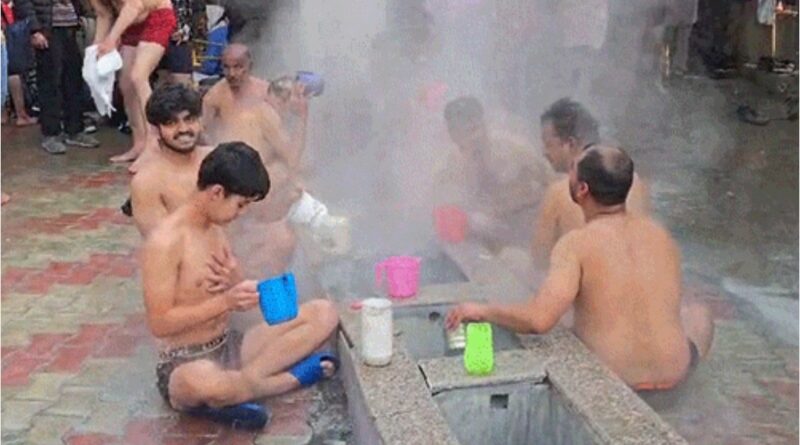
Thousands gather for a holy winter dip at Tattapani’s warm springs for Makar Sankranti
Even as temperatures hovered near freezing, thousands gathered at the banks of the Sutlej River on Tuesday for a sacred Makar Sankranti ritual—a dip in the warm, healing waters of Tattapani’s hot springs.
The small pilgrimage town, nestled about 56 km from Shimla, came alive long before dawn. From 4 a.m. onward, devoted men and women stepped into the sulfur-rich, naturally warm waters. To them, this was more than just a bath; it was an act of faith believed to carry both spiritual cleansing and curative power for the skin, particularly welcomed during the biting cold of winter.
The air filled not only with devotion but with the aromas of an ancient tradition. Community kitchens worked tirelessly, stirring giant cauldrons to prepare nearly three quintals of khichdi, distributed as sacred prasad. “My family has been cooking khichdi here for Sankranti for nearly a hundred years,” shared Shimla resident Mohit Sood, whose great-grandfather Bihari Lal began the tradition in the 1920s. This spirit of collective feeding, locals say, traces back to the sacrificial fire rituals of the sage Jamadagni.
Adding to the day’s significance was a touch of living history. Local priest Pandit Tekchand Sharma recounted that the original bathing tank was inaugurated in 1952 by India’s first President, Dr. Rajendra Prasad. Though that site was later submerged by the Kol Dam, the warm springs were lovingly restored along the riverbank, preserving the sacred spot for future generations.
Beyond the rituals, the day was a testament to community and organization. Extra buses ferried pilgrims from across Himachal and neighboring states, while police carefully managed traffic to ensure smooth passage. In a poignant ceremony, Sub-Divisional Magistrate Gaurav Mahajan performed Kanya Pujan, honoring 21 young girls with Vedic chants—a moment he described as reflecting the fair’s true spirit of “social harmony and cultural unity.”
As the sun set on Tattapani, the warmth of the springs seemed to linger—not just in the water, but in the shared faith, history, and togetherness of a community upholding a timeless tradition.