Himachal Apple Growers Sound Alarm Over Trade Deals: “1.5 Million Livelihoods at Risk”
A storm is brewing in the apple orchards of North India. Farmer and horticulturist organizations across Himachal Pradesh have issued a dire warning and a call to action, stating that recent international trade agreements negotiated by the Modi-led central government pose an existential threat to the region’s primary agricultural economy.
The core of the dispute lies in the reduction of import tariffs (taxes) on agricultural products, specifically apples, as part of Free Trade Agreements (FTAs) and Bilateral Trade Agreements (BTAs).
The Tariff Cut: Numbers that Have Farmers Worried
According to statements from united farmer bodies, the finalization of an FTA with New Zealand has already led to a drastic reduction in the import duty on apples—from 50% to 25%. The duty on pears has been set at 16.5%, and on kiwis at 0%.
A more severe threat looms on the horizon with the upcoming BTA with the United States, which is in its final stages of negotiation. Reports suggest the apple tariff could be slashed from 25% to as low as 0%, opening the floodgates for a massive influx of cheap, subsidized foreign apples.
An Uneven Playing Field
Leaders argue that Indian farmers simply cannot compete on this uneven field. They cite a staggering productivity gap: while developed nations like the USA and New Zealand yield 70-80 tonnes of apples per hectare, Indian productivity languishes at 6-8 tonnes per hectare. Compounding this, farmers in those countries benefit from significantly higher government subsidies, allowing them to produce at a much lower cost.
“The result will be the dumping of cheap foreign apples in our market,” said Sanjay Chauhan, Co-Convener of the United Kisan Manch. “Our apples, grown at a higher cost on challenging terrains, will not be able to compete. This isn’t just about profits; it’s about the survival of an entire way of life.”
The groups estimate that the livelihoods of nearly 1.5 million families across the apple-growing belt of Himachal Pradesh, Jammu & Kashmir, and Uttarakhand are now under severe threat.
A Unified Front Demands Action
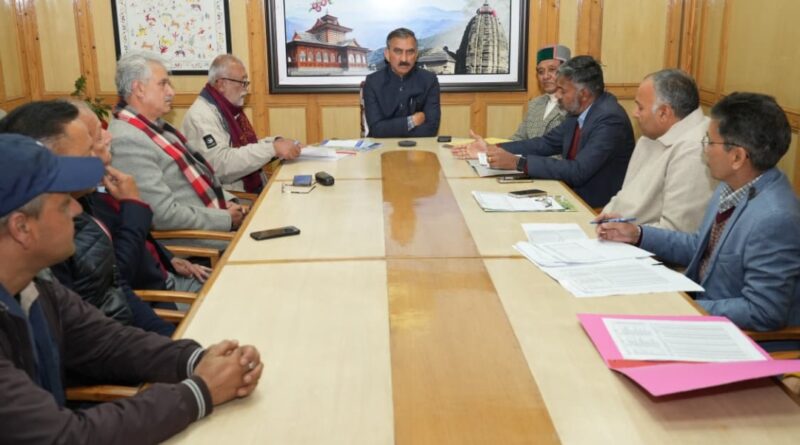
In a significant move, a coalition of major organizations—including the Himachal Kisan Sabha, Himachal Apple Producers Union, and Progressive Growers Association—today met with the state’s Chief Minister. They presented a clear, two-fold demand:
- Immediate Intervention: They have urged the Chief Minister to lead an all-party delegation of state MPs and MLAs, alongside farmer representatives, to meet the Prime Minister. Their goal is to secure a complete exclusion of apples and other sensitive agricultural products from ongoing and future FTAs.
- A Demand for Protection: They are demanding that the import tariff on apples be raised to a protective minimum of 100%.
The message to the state government was unequivocal. “If the Centre does not heed our demand,” the organizations stated, “we expect the Chief Minister to coordinate with the Jammu & Kashmir government and farmers to plan a united ‘March to Delhi.’ The farmers of Himachal will join this movement en masse.”
The Call for a Sustained Movement
Beyond governmental lobbying, the farmer bodies have issued a clarion call for a pan-India movement. They are appealing to all farmer and horticulturist associations across the country to unite and build relentless pressure on the central government.
“The movement to keep agriculture out of these lopsided trade deals will continue,” Chauhan asserted, “until the government listens to the voice of the annadata (food provider) and reverses its disastrous decision.”
The coming weeks are likely to see heightened political activity and mobilization in the Himalayan states, as the apple-growing community prepares for a tough fight to protect its orchards and its future.