Where Flowers Touch the Sky: Ladakh Blooms with India’s Highest Lilium Garden
In the rugged, windswept landscapes of Ladakh, where farming is often challenged by extreme weather and high altitudes, a remarkable transformation has taken place. Vast stretches of colourful blooms now brighten the villages of Choglamsar and Stakna near Leh, marking the creation of India’s largest Lilium flower garden at the country’s highest elevation.
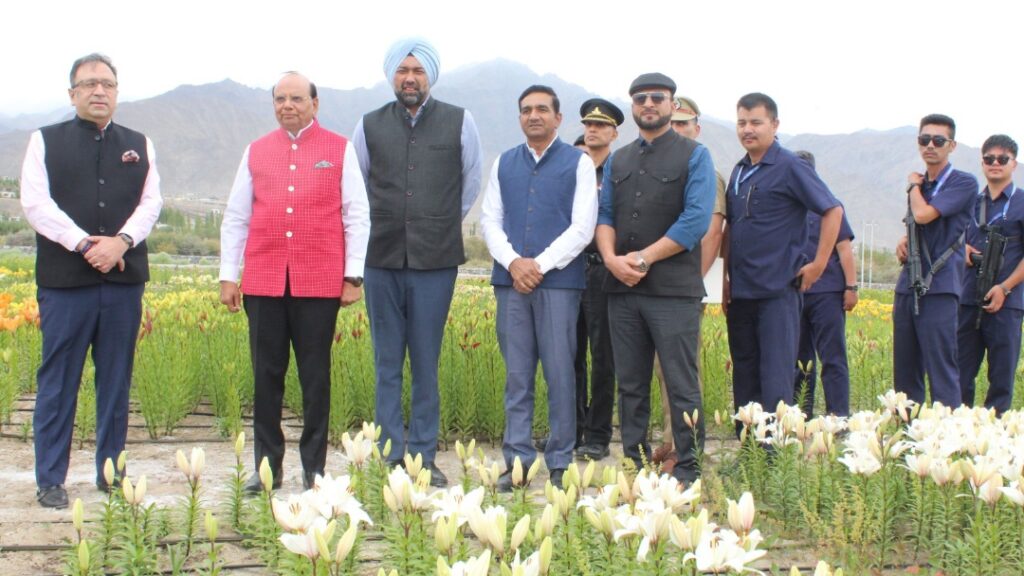
A joint initiative of CSIR-Institute of Himalayan Bioresource Technology (CSIR-IHBT), Palampur, and the Department of Agriculture, Leh, has turned nearly 40 acres of land into a vibrant floral paradise. The gardens are home to over 25 lakh flowers, including around 24 lakh Lilium blooms and one lakh Gladiolus, showcasing the immense potential of high-value floriculture in the cold desert region.
The flower gardens were inaugurated by the Lieutenant Governor of Ladakh, Shri Vinai Kumar Saxena, in the presence of Dr. Sudesh Kumar Yadav, Director of CSIR-IHBT. The occasion also coincided with the birth anniversary of Prime Minister Narendra Modi, adding significance to an initiative that blends science, agriculture and rural development.
What makes this achievement even more impressive is the speed at which it was realised. Developed within just two months, the project stands as a testament to the power of collaboration and innovation. By introducing advanced floriculture technologies suited to challenging mountain conditions, the initiative aims to diversify agriculture, increase farmers’ incomes and open new livelihood opportunities for local communities.
For CSIR-IHBT, the project is more than a flower garden. It is a demonstration of how science can empower remote regions. According to Director Dr. Sudesh Kumar Yadav, these gardens are envisioned as centres of commercial flower production, farmer training, technology transfer and even agri-tourism. The goal is to encourage Ladakh’s youth and farming communities to explore entrepreneurship through floriculture and related value-added activities.
The initiative is expected to serve as a learning hub where farmers can gain hands-on experience in scientific cultivation practices while combining them with traditional farming wisdom. Such efforts could inspire a new generation of entrepreneurs to build flower-based enterprises and contribute to the region’s economic growth.
Beyond agriculture, the blooming fields are set to become a new attraction for visitors. Against the backdrop of Ladakh’s majestic mountains, the colourful floral landscapes have the potential to draw tourists, creating additional income streams for local businesses and encouraging rural economic development.
The Choglamsar and Stakna flower fields symbolize more than horticultural success. They represent a vision where agriculture, innovation and tourism work together to create sustainable opportunities in one of India’s most challenging environments. As thousands of Lilium flowers bloom beneath Ladakh’s clear blue skies, they also signal a promising future for farmers, entrepreneurs and the Himalayan economy.
Through this pioneering effort, CSIR-IHBT and the Department of Agriculture, Leh, have demonstrated that with the right blend of science and determination, even the highest and harshest landscapes can flourish with new possibilities.