Groundwater in BBN Industrial Belt Shows Serious Contamination Risk, Study Finds
Groundwater in the Baddi–Barotiwala–Nalagarh (BBN) industrial belt of Himachal Pradesh is facing serious quality concerns, with a new study finding that a large majority of tested samples were unsuitable for drinking.
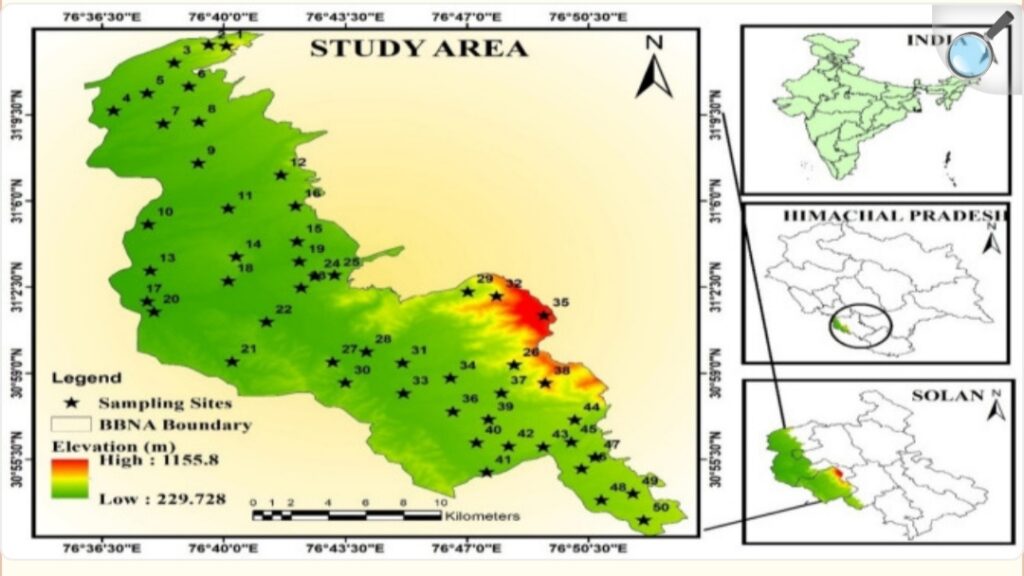
The study, which examined groundwater in the rapidly industrialising northwestern Himalayan region, assessed 50 groundwater samples for 13 physicochemical parameters, along with potential health risks associated with fluoride and arsenic contamination.
According to the findings, several parameters—including total hardness, calcium, magnesium, sodium, chloride, fluoride, potassium, bicarbonate and arsenic—were found to exceed permissible limits in a number of samples.
The Drinking Water Quality Index (DWQI) assessment showed that 78 per cent of the groundwater samples were unsuitable for drinking purposes. The researchers attributed the deterioration to excessive salts, high hardness and the presence of fluoride and arsenic.
Arsenic risk raises concern
The health-risk assessment found significant potential carcinogenic risks associated with arsenic exposure. Lifetime Cancer Risk (LTCR) exceeded the acceptable benchmark in 92 per cent of samples for children, 88 per cent for females and 86 per cent for males.
The researchers noted that children could be particularly vulnerable to the potential health effects of contaminated groundwater.
Fluoride contamination also emerged as a concern. Elevated Hazard Quotient (HQ) values were recorded in 12 per cent of samples for males and children, compared with 2 per cent for females. The findings indicate potential non-carcinogenic health risks, including concerns related to dental and skeletal fluorosis.
Industrial growth and groundwater pressure
The BBN region is one of Himachal Pradesh’s major industrial centres, with substantial pharmaceutical and manufacturing activity. With groundwater serving as an important source of drinking water, the researchers have highlighted the need for stronger safeguards against contamination.
The study recommends stricter enforcement of pollution-control regulations and ensuring that all industrial units are connected to properly functioning effluent treatment plants.
Other measures suggested include continuous groundwater-quality monitoring, artificial recharge, rainwater harvesting, adoption of salt-tolerant crops and community-level defluorination measures.
The researchers have also suggested technologies such as electrocoagulation for removing industrial contaminants, along with switching to safer groundwater sources wherever necessary.
Need for long-term groundwater management
The study emphasises that restoring groundwater quality will require sustained monitoring and coordinated intervention. The researchers said sustainable groundwater use is particularly important in the ecologically fragile Himalayan region.
At the same time, they acknowledged that the assessment has certain uncertainties because factors such as exposure rates, parameter weighting, seasonal variations and local behavioural differences may affect the results.
Future research, they suggested, should incorporate probabilistic or uncertainty modelling and isotope-based hydrogeochemical tracing to identify contamination sources more precisely.
The study’s findings are also linked to the United Nations Sustainable Development Goals, particularly SDG 6 on clean water and sanitation and SDG 3 on good health and well-being.
The research was supported by the Departments of Environmental Science, Chemistry and Industrial Chemistry at Sardar Patel University, Mandi, with laboratory support for heavy-metal detection from IIT Mandi.