Concrete in the River: Kullu Residents Challenge NHAI’s Retaining Wall in the Beas
A legal notice filed this week demands an immediate halt to RCC construction in the riverbed along the Kullu–Manali highway, citing a landmark Supreme Court ruling that directly addressed interference with the Beas.
a
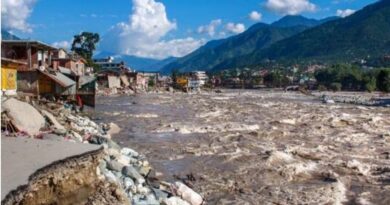
When the Beas River surges during monsoon, it doesn’t just carry water. It carries boulders, silt, and the weight of everything upstream. Now, a public action committee is asking whether the concrete being poured into its bed will make things worse.
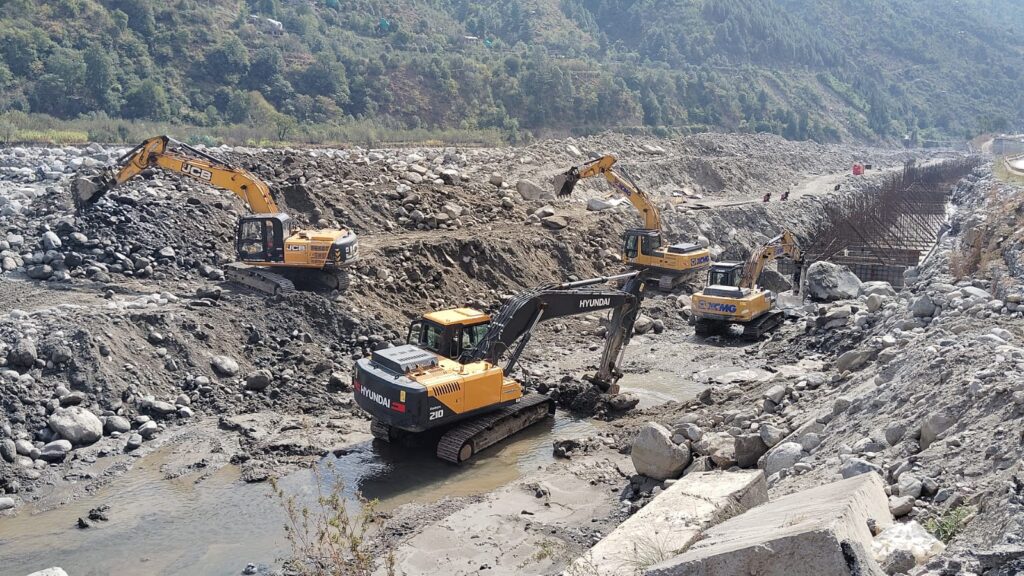
On October 19, 2026, the Public Action Committee (PAC) MattewaraSutlej served a legal notice to the National Highways Authority of India (NHAI), the Ministry of Road Transport and Highways, and the Ministry of Environment, Forest and Climate Change, demanding an immediate suspension of Reinforced Cement Concrete (RCC) retaining wall construction within the active riverbed and along the banks of the River Beas in Kullu district.
The notice, accompanied by photographs taken on October 18, raises a deceptively simple question: just because a road needs protecting, does that mean a river must be concreted?
The Concerns
The PAC’s notice lays out a detailed case. Construction within the active river channel, it argues, interferes with the natural movement of water and sediment, alters channel morphology, obstructs flood conveyance, increases erosion at adjoining locations, and aggravates downstream flood risks.
These are not abstract fears. In a Himalayan river system characterized by variable flows, heavy sediment transport, and sudden spikes in discharge during extreme rainfall, what happens at one point in the river rarely stays there.
“The River Beas is a natural public resource, not merely a corridor for infrastructure development,” the notice states. “Highway protection and environmental protection must be achieved together—through lawful, scientifically justified and ecologically responsible engineering.”
Environmentalist Guman Singh of Himalaya Niti Abhiyan cautioned against modifying river courses, saying projects in active riverbeds should undergo proper scientific assessment to avoid disturbing water flow and sediment balance.
A Supreme Court Ruling That Speaks Directly to the Beas
The notice leans heavily on a landmark judgment that anyone working on the Beas should know by heart.
In M.C. Mehta v. Kamal Nath (1996), decided on March 15, 2002, the Hon’ble Supreme Court directly addressed construction and interference with the natural course of the River Beas in Himachal Pradesh. The case involved concrete studs, stepped walls, concrete bars, and bunds constructed on the banks and bed of the Beas that interfered with its natural flow.
The Court applied the public trust doctrine—the principle that the State holds natural resources like rivers in trust for the public and future generations—and upheld exemplary damages under the Polluter Pays Principle.
The message was unambiguous: riverbeds, banks, and natural drainage corridors are not ordinary construction sites.
The PAC argues that the ongoing RCC retaining wall construction raises the same fundamental questions. Has NHAI demonstrated that the work doesn’t unlawfully interfere with the natural channel? Has it shown that the construction won’t obstruct flood flows or cause avoidable ecological damage?
If not, the notice argues, the work raises “a serious question of compliance with the principles laid down by the Hon’ble Supreme Court.”
What the NGT Is Already Examining
The notice also points to an ongoing matter before the National Green Tribunal: Sugandha v. Ministry of Road Transport and Highways & Ors. (Original Application No. 610 of 2023).
That case has addressed concerns about highway construction in Himachal Pradesh, including examination of highway alignment, the highest flood level (HFL), whether actual construction falls within the visible HFL line, and whether highway work intrudes into floodplain areas.
The PAC also invokes NGT jurisprudence from M.C. Mehta v. Union of India, which dealt with Ganga floodplain protection. While acknowledging that those directions were specific to the Ganga, the notice argues that the underlying principles—floodplain protection, scientific assessment, and prevention of irreversible damage—apply equally here.
The Precautionary Principle: Why Wait?
Section 20 of the National Green Tribunal Act, 2010, requires the Tribunal to apply the principles of sustainable development, the precautionary principle, and the polluter-pays principle.
The precautionary principle is straightforward: when consequences may be serious or difficult to reverse, environmental risks should be assessed before potentially harmful activities proceed. This matters even more when construction may affect a river’s flow, sediment transport, flood-carrying capacity, or adjoining banks.
The PAC’s notice asks a pointed question: where are the hydrological studies? The flood-level calculations? The environmental permissions? The competent-authority approvals?
If those documents haven’t been disclosed, the notice argues, the appropriate course is immediate verification—and preventing further alteration of the river channel until legality and environmental safety are established.
What the PAC Demands
The notice calls upon the authorities to:
- Suspend the RCC construction within the riverbed and along the banks immediately, ensuring compliance with judicial and environmental mandates before proceeding further.
- Furnish a complete, point-wise reply with supporting documents within seven days.
- Provide a copy of the joint inspection report and the decision taken on the committee’s complaint.
- Remove all illegal construction from the riverbed and banks, and ensure restitution of the waterbody as per law.
The notice also warns that if work continues in the face of these concerns, the PAC reserves the right to approach the NGT seeking interim protection, independent expert assessment, disclosure of project records, and restoration of the affected environment.
The Bigger Picture
The Kullu–Manali highway is a lifeline. It connects communities, carries tourists, and supports livelihoods. Protecting it is a legitimate public purpose.
But the PAC’s notice raises a question that resonates far beyond this stretch of road: at what cost?
The Beas is a para-glacial river with heavy sediment loads. It snakes and shifts. It carries the memory of the 2023 floods and the 2024 floods, both of which left scars on the valley that haven’t healed. Communities in Sainj and Malana are still waiting for resettlement. Apple orchards remain buried under silt. The demand for rehabilitation has only grown louder.
Against this backdrop, the notice’s central argument is difficult to dismiss: if the state is going to pour concrete into a river that has already shown its power to destroy, it should at least be able to prove—with studies, approvals, and scientific assessments—that the work won’t make the next disaster worse.
The alternative, the notice suggests, is to proceed “at the risk of causing potentially irreversible damage to a natural public resource, contrary to the precautionary principle and the State’s public-trust obligations.”
What Happens Next
The NHAI and other authorities have seven days to respond. Whether they provide the requested documents and suspend construction remains to be seen.
What is clear is that the battle over the Beas is not just about one retaining wall or one highway project. It is about the kind of relationship the state wants to have with its rivers—one where infrastructure and ecology are weighed together, or one where concrete wins by default.
As the PAC’s notice puts it: “Riverbeds, their banks and natural drainage corridors cannot be treated as ordinary construction sites where engineering works may be undertaken without regard to the river’s ecological functions.”
The Beas, it seems, is about to test that principle once again.
The Public Action Committee (PAC) MattewaraSutlej is a Ludhiana-based public interest group. Their legal notice, dated October 19, 2026, is addressed to the Principal Secretary, Ministry of Road Transport and Highways; the Chairman, NHAI; the Regional Officer/Project Director, NHAI Shimla; and the Regional Officer, MoEFCC Shimla, with copies to the Chief Secretary of Himachal Pradesh, the Principal Secretary (Environment), the Member Secretary of the HP State Pollution Control Board, and the Deputy Commissioner of Kullu.