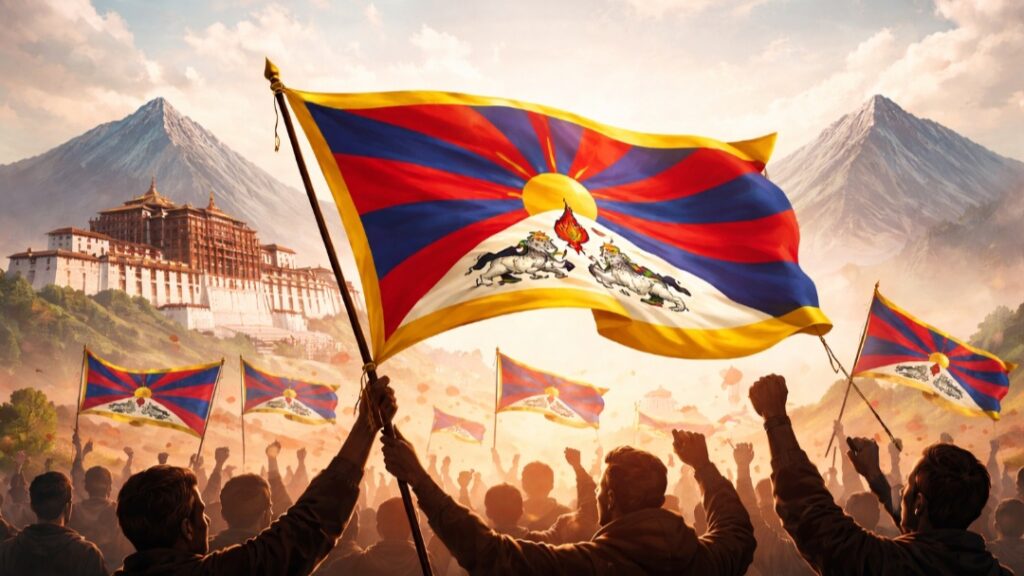
Tibet’s Identity Under Pressure as Assimilation Policies Deepen
As Tibetans worldwide mark Tibetan National Identity Preservation Week, concerns are growing over policies that critics say are accelerating the erosion of Tibetan language, culture, and religious traditions under China’s new Ethnic Unity Law, implemented on July 1, 2026.
A newly released briefing by the Central Tibetan Administration (CTA) argues that the law reinforces long-standing measures promoting a single Chinese national identity while narrowing space for Tibetans to preserve their distinct heritage. According to the report, changes are visible across education, religion, governance, and community life.
Traditional Tibetan festivals in regions such as Lithang, Yulshul, and Nagchu are increasingly centered on state-led patriotic ceremonies, while Tibetan language usage among children is reportedly declining as Mandarin becomes dominant in schools.
Religious institutions, long viewed as custodians of Tibetan culture, are also facing mounting restrictions. The report cites renewed demolitions at Larung Gar, one of the world’s largest Tibetan Buddhist academies, and highlights the case of monk Gonpo Tsering, who is reportedly in critical condition following detention linked to protests against a hydropower project in Derge.
Authorities have also reportedly tightened controls on religious practices, pilgrimages, and cultural observances, while requiring participation in state-sponsored patriotic activities. Critics argue that these measures increasingly link religious expression to political loyalty.
The briefing further points to displacement caused by housing demolitions, relocation programs, labor-transfer schemes, and expanding mining projects. Observers warn that these changes threaten traditional livelihoods and weaken Tibetans’ deep cultural and spiritual ties to their ancestral lands.
Environmental concerns form another key part of the report, which raises questions about the impact of planned mining expansion in the Yarlung Tsangpo basin and the possible downstream effects on neighboring regions.
The CTA concludes that these developments represent a broader pattern of assimilation that could undermine the transmission of Tibetan language, religion, and culture to future generations. It has called on the international community to raise these issues in diplomatic engagements, seek transparency regarding detained religious figures, protect Tibetan cultural institutions, and support independent assessments of major development projects in Tibetan areas.