Bilaspur’s Pomegranate Boom: How 45 Farmers Are Writing Their Own Success Story
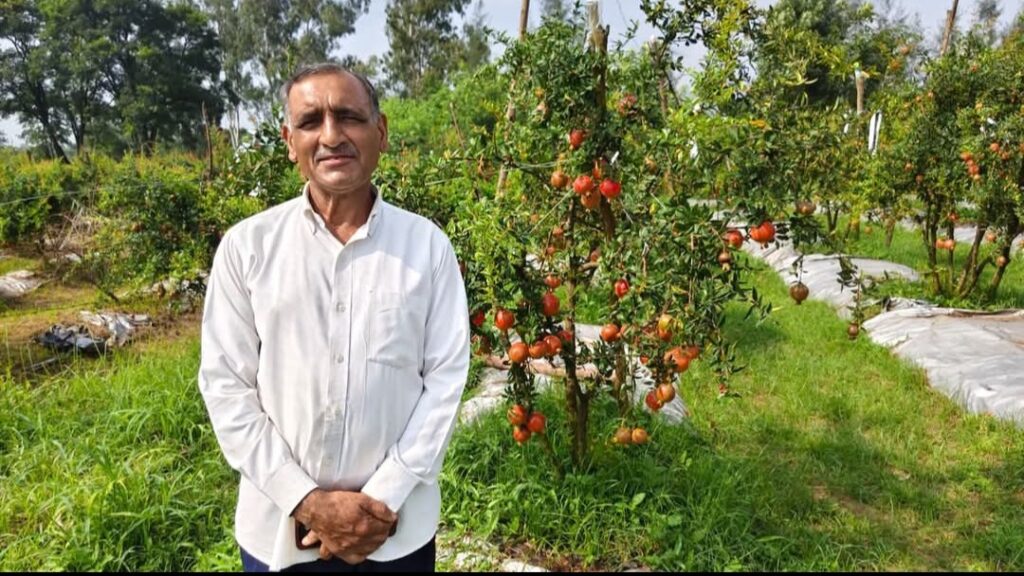
Take a walk through the Tehri cluster in Bilaspur’s Barthin area right now, and you’ll see a spectacle that feels almost magical. Lush green orchards stretch across the hillsides, weighed down by glossy, deep-crimson pomegranates—each one carrying the sweat, hope, and determination of 45 local farmers. Thanks to the state government’s ambitious HP SHIVA project, this once-quiet patch of land is now buzzing with activity and, more importantly, profit.
It wasn’t always this way. Back in 2021, the Horticulture Department started small, planting pomegranate saplings on just 2 hectares as a trial. But seeing the potential, they expanded aggressively in 2022, bringing on board 45 farmers and covering 9 hectares (roughly 100 bighas) to form a dedicated cluster. Today, that cluster boasts 8,555 plants of the premium ‘Bhagwa’ variety, and the numbers are looking incredibly sweet. While last year’s harvest yielded 32 metric tons despite heavy rains, this season the target is a whopping 70 metric tons.
Just ask Prem Lal Nadda, one of the farmers whose life has turned around. Standing in his orchard, he recalls the journey with a sense of pride. “The department gave us the saplings as a trial in 2021, and by 2022 we had formed this cluster,” he shares. “Last year, even with all that devastating rain, we still managed to sell about Rs. 32 lakh worth of pomegranates to Reliance, the local mandis, and directly to customers. After all the costs, we walked away with a clean profit of about Rs. 15-16 lakhs.” For Nadda, this isn’t just about numbers; it’s about stability.
Another farmer, Rajendra Pal, who has around 2,000 plants in the cluster, echoes that sentiment. He points out that the government hasn’t just left them to fend for themselves. “The Horticulture and Jal Shakti departments have been right there with us, helping with land preparation, solar fencing, and—most importantly—water,” he says. He gestures toward the drip irrigation lines snaking through the property, a facility that cost the government roughly Rs. 3-4 crore to set up. “Now we can give fertilizers and sprays right on time. It’s a lifesaver.”
For Rajendra Pal, however, the most heartwarming part of this success isn’t just the profit—it’s the future it promises. “These days, our young people are leaving home, heading to cities just to scrape together a living. But if they see that horticulture can pay this well, they’ll stay. They’ll make good use of the land and earn a respectable living right here, in their own village.” It’s a powerful vision, and one that’s slowly coming true.
Officials are equally optimistic. Dr. Jagdish Chand Verma, the Deputy Director of Horticulture, explains that the Tehri cluster is the district’s only dedicated pomegranate hub. “We are also playing matchmaker by connecting these farmers with big buyers so they get the best possible prices,” he adds. Looking ahead, he reveals that Phase-2 of the SHIVA project will soon introduce even more exotic fruits to the district—blueberries, avocados, macadamia nuts, and dragon fruit—and the land requirement has been relaxed from 10 hectares to just 3, making it easier for smaller groups to participate.
With the state government pumping a massive Rs. 325 crore into the SHIVA project this financial year, and Deputy Commissioner Rahul Kumar urging more locals to climb aboard, the message is clear: Bilaspur’s farmers are no longer just growing crops—they’re growing fortunes. For these 45 families, the future looks as bright and red as the pomegranates hanging over their heads.