Assess Mountain Carrying Capacity Before Development Decisions: Dr. D. Raghunandan
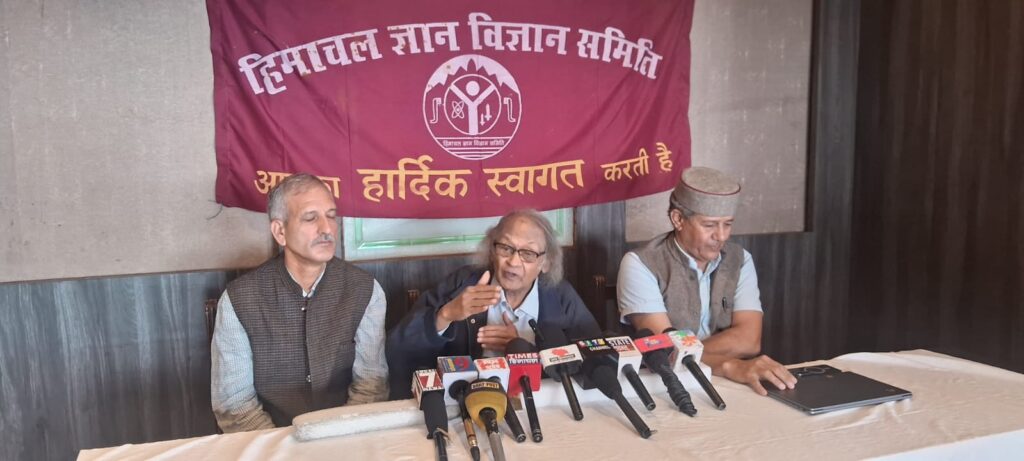
In a press conference organized today by the Himachal Gyan Vigyan Samiti at Hotel Victory, Shimla, renowned scientist, climate change expert, and former president of the All India People’s Science Network (AIPSN), Dr. D. Raghunandan, said that rising global temperatures over the past few decades have increased the intensity and risk of extreme weather events such as heavy rainfall, erratic monsoons, heatwaves, and other such phenomena across the world and in India. The Himalayan region is particularly vulnerable due to its geographical and geological conditions, which is why the impacts of climate change here could be far more severe.
Dr. Raghunandan stated that in Himalayan states like Himachal Pradesh, unplanned and unscientific development, along with climate change, has also heightened disaster risks. In the construction of four-lane roads, large-scale building projects, and other initiatives, the neglect of the mountains’ geological structure, slope stability, drainage systems, and local ecology has led to landslides and significant alterations to the landscape. He stated that development is necessary, but its form must align with the nature and limitations of the Himalayas.
He emphasized that before permitting large-scale construction and development in any city, tourist area, or sensitive hilly region, a scientific assessment of its carrying capacity must be conducted. Based on this, the state government should regulate and control construction activities, land use, tourism pressure, and infrastructure expansion.
Dr. Raghunandan said that countries around the world must demonstrate strong and long-term commitments to reducing emissions of carbon dioxide and other greenhouse gases into the atmosphere. However, it will take time for the effects of these efforts to become visible. Therefore, relying solely on emission reduction in the coming years will not be sufficient. Governments must simultaneously develop climate-resilient and disaster-resistant systems. Villages, cities, and infrastructure must be prepared in such a way that loss of life and property can be minimized during conditions such as extreme rainfall, floods, landslides, droughts, and rising temperatures.
Dr. O.P. Bhuraita, General Secretary of the Bharat Gyan Vigyan Samiti and environmentalist, said that the pressure of development in Himalayan states has reached a point in many areas where environmental damage is becoming extremely difficult to reverse. Therefore, it is now time to seriously consider where, how much, and what type of development should be undertaken. He stated that tourism in Himachal must also be planned and regulated in accordance with local resources and carrying capacity.
Dr. Bhuraita said that the planning and implementation of policies and projects related to development and the environment should not be limited to government departments alone. Effective participation of local communities, scientists, environmental and development organizations, and other experts must be ensured so that people’s experiences and voices are included in the decision-making process. He stated that after every major disaster, relief and rehabilitation alone are not enough; rehabilitation policies need to be made more comprehensive, sensitive, and safer against future disasters.
Satyawan Pundir, State Secretary of the Himachal Gyan Vigyan Samiti, said that the committee has long been working on issues related to the environment, climate change, and natural disasters through studies, public awareness, and public participation. In the coming times, the committee, along with experts and other organizations, will further strengthen its efforts in policy advocacy, public dialogue, and capacity building of communities at the grassroots level.
He informed that a year-long “Future of India” campaign is being launched across the country, including in Himachal Pradesh. Under this campaign, village-level studies will be conducted on key issues such as the environment, health, self-reliance, agriculture, and livelihoods. Through dialogue with people at the gram panchayat level, their experiences, problems, and suggestions will be documented. Subsequently, dialogues and public hearings will be organized at the block, district, and state levels to try to bring the voices of ordinary people into the policy-making process.
Satyawan Pundir said that under this campaign, the Himachal Gyan Vigyan Samiti will strive to reach over 1,000 gram panchayats across more than 40 development blocks in the state and foster extensive public participation.
The main message of the press conference was that halting development is not the solution for Himachal; rather, it is essential to change the direction and nature of development to align with the ecological limits of the Himalayas. Amid the growing threat of climate change, scientific planning, the region’s carrying capacity, disaster preparedness, the participation of local communities, and environmentally friendly development must be brought to the center of the state’s development policy.