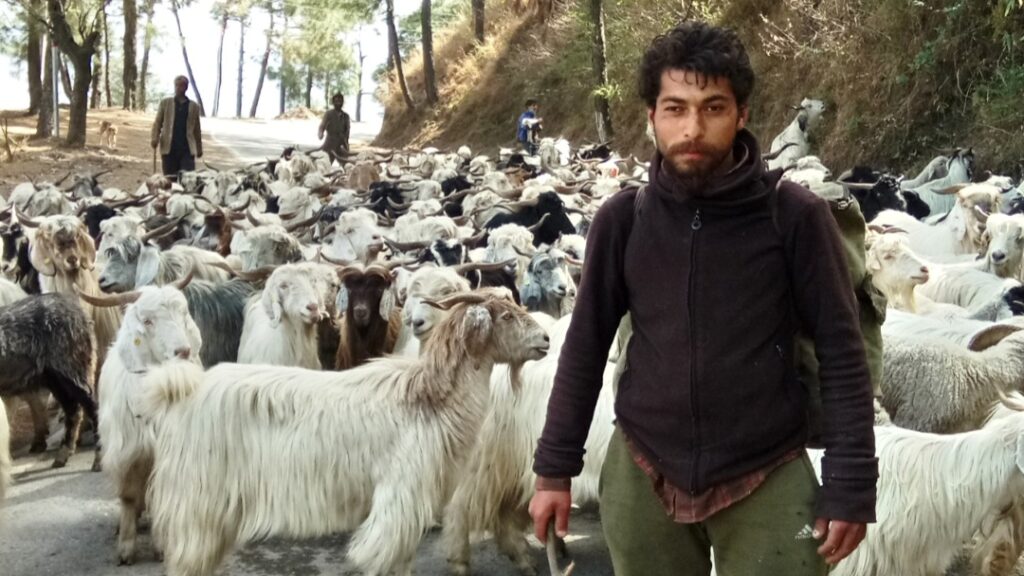
As Summer Sets In, Himachal’s Nomadic Shepherds Begin Their Age‑Old Mountain Journey
As temperatures soar in the lower parts of Himachal Pradesh, nomadic sheep herders once again begin their seasonal migration to the cooler mountain pastures. This age-old movement—from plains in winter to high-altitude regions in summer—has been a way of life for generations of shepherding communities across the state.
Braving scorching heat, monsoon rains and biting cold, shepherds live under open skies with their sheep and goats throughout the year. During the summer months, many of them move deep into the forests and alpine pastures of Narkanda, Kinnaur and Dodra Kwar, where grazing conditions are better and temperatures more bearable for their animals.
Chhering, a nomadic shepherd from Chitkul in Kinnaur, says sheep and goat rearing has been his family’s traditional occupation. To preserve this heritage, he spends the entire year away from home. “Life is tough, but I am used to it now. Living without shelter in all seasons is not easy, but this is the only life I know,” he says. Chhering also points out that the profession is slowly disappearing in Kinnaur, with only a few families continuing it. He attributes this decline largely to better education and alternative career choices among the younger generation.
Echoing similar concerns, Ramdas, a shepherd from Dodra Kwar, says shrinking pastureland has become a major challenge—especially in the lower regions. “Earlier, grazing land was easily available and permits were not difficult to get,” he recalls. “Now, encroachments on shamlat land have made grazing increasingly difficult, forcing many shepherds to give up this occupation altogether.”
Despite these challenges, nomadic sheep herding remains an important livelihood in remote areas such as Kinnaur, Dodra Kwar, Chamba and Pangi. According to the Animal Husbandry Department, sheep rearing is practiced across six districts—Chamba, Kangra, Kullu, Shimla, Kinnaur and Sirmaur. The state is home to nearly 1.9 million sheep and goats, and about 60 per cent of them are managed by nomadic pastoralists.
To support these communities, the Himachal Pradesh Wool Federation regularly organizes awareness camps and welfare initiatives. Through these efforts, shepherds are provided with essential items such as solar lights, first-aid kits and tarpaulins free of cost. The Federation also helps ensure fair returns for their hard work by purchasing wool at reasonable prices. For this purpose, special wool collection centres have been set up at various locations across the state.
While modernization and land pressures threaten this traditional lifestyle, the seasonal movement of shepherds into Himachal’s highlands remains a powerful reminder of a culture deeply intertwined with nature—resilient, self-reliant and rooted in centuries of tradition.