From Chemical Farming to Natural Hope: How Ravi Dutt Turned His Life Around
He walked away from expensive chemical farming, embraced nature, and is now growing more while spending less—right in his own village.
Meet Ravi Dutt—a 47-year-old farmer from Dhamthal village in Bilaspur’s Jukhala area. His story isn’t about big machinery or high-tech greenhouses. It’s about something simpler: listening to the land.
Like most farmers around him, Ravi once relied heavily on chemical fertilizers and pesticides. But over time, the costs kept climbing while the soil seemed to be giving up. Something had to change.
In 2018, he decided to take a leap of faith—he switched to natural farming. Today, his fields are lush with maize, wheat, millet, pulses, peas, tomatoes, and other vegetables. And here’s the best part: his produce is not only kind to the environment but also healthier for everyone who eats it.
“I used to do exactly what other farmers did,” Ravi recalls with a gentle honesty. “But the more chemicals I used, the more I needed. My soil was suffering, and so was my wallet.”
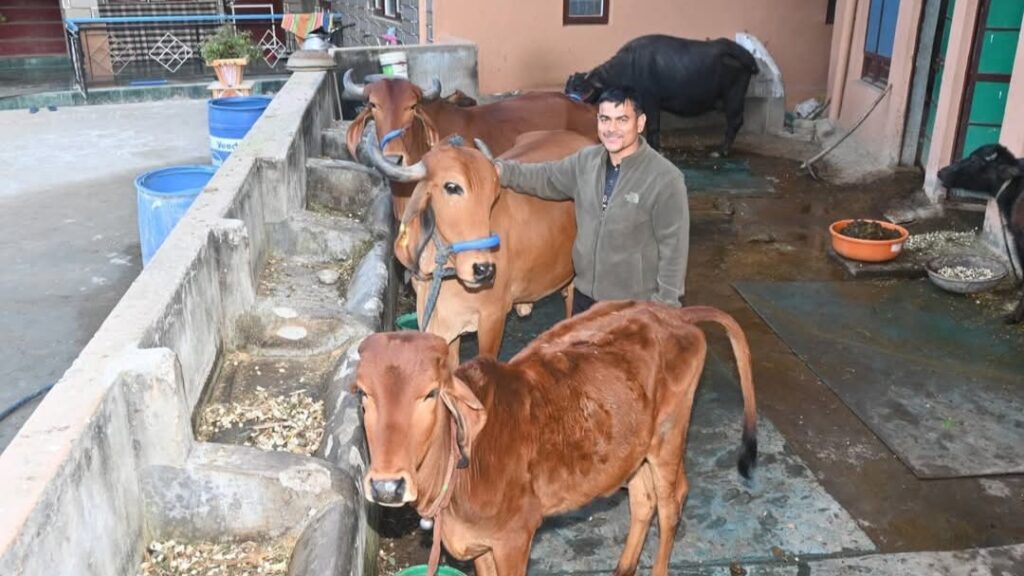
That’s when he learned about natural farming. He didn’t just stop at changing his methods—he brought home a native Gir cow. Now he has two cows and a calf. Their dung and urine? Gold for his fields. He turns them into jivamrit and other natural concoctions that feed the soil, not poison it.
Last year alone, Ravi sold about 4 quintals of naturally grown maize through the local ATMA Project. At ₹40 per kilo, that brought him ₹1,600. And that’s just maize. He’s also growing wheat and other traditional crops that fetch good prices.
“The government has done a wonderful thing by fixing support prices for natural crops like wheat, maize, and turmeric,” Ravi says with a smile. “Thousands of farmers like me are finally seeing the difference.”
What the officials have to say:
Kulbhushan Dhiman, Deputy Director of Agriculture, shares that natural farming took root in Bilaspur district back in 2018. “Today, around 8,000 farmers have joined this movement,” he says. “They’re farming naturally across 1,094 hectares.”
He adds that in 2025-26 alone, the district purchased about 116 quintals of turmeric from 85 farmers, 49 quintals of maize from 32 farmers, and 62 quintals of wheat from 42 farmers—all at government-set support prices (₹90 for turmeric, ₹40 for maize, and ₹60 for wheat per kilo).
Deputy Commissioner Rahul Kumar puts it simply: “We’re working hard to implement government schemes and decisions on time. The goal is to make sure that every eligible person gets the benefits they deserve—without unnecessary delays.”