Himachal receives continued central support in tourism, infrastructure, and disaster relief : Gajendra Singh Shekhawat
Congress continues to spread confusion about apples and agriculture
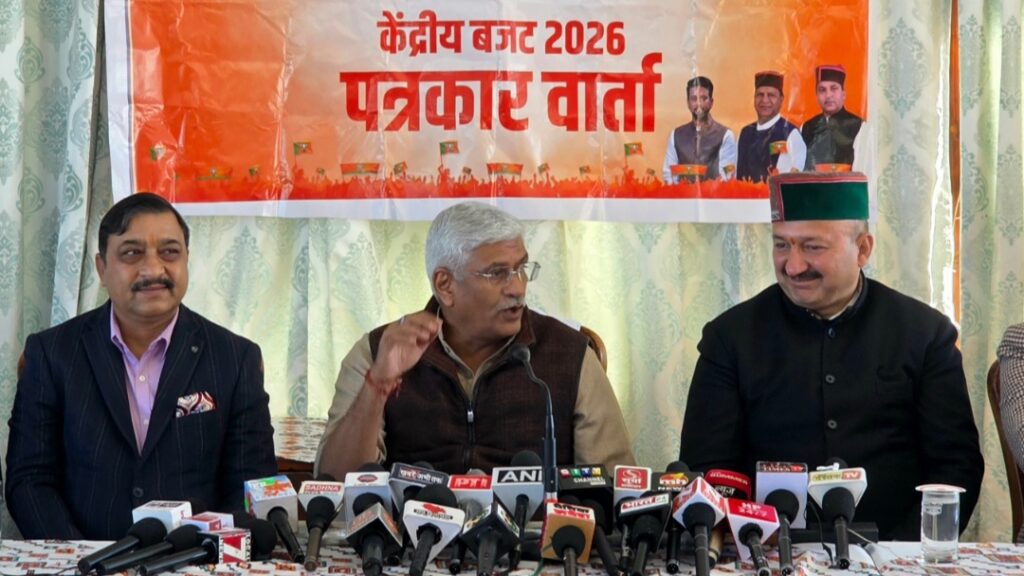
Shimla, Union Minister of Culture and Tourism, Shri Gajendra Singh Shekhawat, while speaking at length on Budget 2026, India’s economy, recent international trade agreements and financial issues related to Himachal Pradesh in a detailed press conference held in Shimla, said that India stands on a strong economic base today and in the coming years, golden opportunities are going to open up in the markets of Europe and America for textiles, handicrafts, electronics, mobiles, consumer goods and agricultural products. He said that the recent trade agreements have been called the “Mother of All Deals” globally.
The Union Minister, while specifically clarifying the issue of RDG (Revenue Deficit Grant), said that this scheme was originally introduced as a temporary relief to provide support for a limited period to states facing severe fiscal deficits. Starting from the 12th Finance Commission, this provision was repeatedly extended with warnings, but it was never considered a permanent arrangement. During the 15th Finance Commission, front-loaded and record levels of assistance were given to states in extraordinary circumstances like Covid. He said that Himachal Pradesh also received much higher RDG assistance during this period than in all previous periods.
He said that the Finance Commission has now clarified that instead of continued grants, states must move towards increasing revenue and adopting expenditure discipline. Shekhawat said that fiscal deficit is a matter of difference between income and expenditure and can be addressed through structural reforms, not just political rhetoric. He expressed concern that Himachal’s debt-to-GDP ratio exceeding 40% is a sign of caution and the state should take concrete steps towards long-term fiscal discipline.
The Union Minister said that the Central Government has made a structural increase in tax sharing (devolution) under the new formula of the Finance Commission, due to which states like Himachal are getting a higher share and this can largely offset the impact of reduction in RDG, provided the states strengthen their financial management.
Regarding Himachal, he said that the central government has consistently supported tourism and cultural development. Recently, under the Special Capital Assistance Scheme, Himachal was approved a 50-year, interest-free long-term loan for tourism infrastructure development, which is practically a grant. The state has also received ongoing assistance under Swadesh Darshan, PRASAD, Challenge-Based Destination, and other schemes, and this support will continue as project proposals are received.
On the issue of natural disasters, he said the central government has increased SDRF and NDRF funds several-fold over the years, and states have been allowed to spend not only on relief but also on preventive measures. He urged state governments to invest more in disaster preparedness in the era of climate change.
Addressing questions about the India-US trade agreement and agriculture, Shekhawat stated that the interests of farmers, dairy, pulses, grains, vegetables, and spice producers are fully protected. No market access has been granted for wheat, rice, pulses, basic vegetables, dairy products, spices, and most fruit categories. He stated that Congress is unnecessarily politicizing the apple issue. Apples imported from abroad cannot come to India at a landing price below ₹100—import is possible only after a minimum base price of approximately ₹80, plus taxes ranging from ₹20 to ₹40—so the interests of local orchardists are protected.
The Union Minister said that Budget 2026, recent trade agreements, infrastructure investment and manufacturing thrust together will play a decisive role in making India a developed nation and Himachal Pradesh will also benefit from it in a big way.
Tourism is a major growth engine of India’s economy, Himachal Pradesh gets special interest-free assistance for tourism infrastructure – Gajendra Singh Shekhawat
Budget 2026 to focus on heritage sites, hospitality, tour guide training and high-value agricultural crops
Addressing a press conference in Shimla, Union Minister of Culture and Tourism, Shri Gajendra Singh Shekhawat, said that tourism has become a major driver of India’s economy and, for states like Himachal Pradesh, a key driver of development. He said that Himachal’s natural and cultural wealth is attracting tourists from both India and abroad, and the central government is taking special steps to strengthen tourism-based infrastructure.
He informed that Himachal Pradesh has recently been approved a long-term, 50-year, interest-free loan for the development of the tourism vertical under the central government’s Special Assistance to States for Capital Infrastructure (SASCI) scheme, which is practically a grant. He said this will provide a new impetus to tourism infrastructure, facilities, and connectivity in the state.
The Union Minister stated that Budget 2026 announced the development of 15 major archaeological sites as world-class experience destinations. He explained that instead of simply excavating and abandoning the sites, they will now be scientifically developed into tourist experience centers, following the successful model developed in Vadnagar, Gujarat. Similarly, new heritage experience zones will be developed across the country.
Shekhawat said that given the rapidly growing tourism and hotel sectors in the country, there is a growing need for trained human resources. To this end, the budget has included a provision to establish a National Hospitality Institute to develop technically skilled professionals. Additionally, 10,000 tourist guides at selected tourist destinations will be trained in modern technology, AR-VR, and digital tools.
He said that provision has also been made in the budget for the development of trekking trails, birding trails and special eco-tourism circuits, which will directly benefit states like Himachal.
Referring to the agriculture sector, the Union Minister said that the budget has placed a special focus on high-value crops—coconut, cashew, cocoa, and sandalwood—to increase farmers’ incomes. Provisions have also been made to increase processing capacity, strengthen alternative income sources, and encourage sectors such as self-help groups, animal husbandry, fisheries, and beekeeping.
He said the government’s goal is to ensure farmers’ incomes are not solely dependent on traditional farming, but to multi-facet the rural economy through value addition, processing, and exports. Budget 2026 aims to advance both tourism and agriculture as strong pillars of growth.
Modi government has taken India from despair to confidence and from a fragile to a robust economy – Gajendra Singh Shekhawat
Budget 2026: A roadmap for continuity, reform, self-reliance and inclusive growth
Addressing a press conference in Shimla, Union Minister for Culture and Tourism, Shri Gajendra Singh Shekhawat said that India has been moving forward on a clear path and with a clear goal since the formation of the government under the leadership of Prime Minister Shri Narendra Modi in 2014. He said that before 2014, the country was going through a period of corruption, policy instability and economic despair, but due to decisive policies and structural reforms in the last 11 years, India today stands respectably at the fourth position among the top strong economies of the world and is rapidly moving towards the third position.
He said that Budget 2026 is a budget of continuity, emphasizing stability, inclusiveness, and sustainable development. This budget is based on the principles of “Action over Ambivalence, Reform over Rhetoric, and People over Popularity”—that is, decisive decisions, not ambivalence; real reform, not mere announcements; and people empowerment, not popularity, is the government’s priority.
The Union Minister said the government has identified seven key pillars in the budget—strengthening manufacturing, heritage conservation, MSME empowerment, robust infrastructure, urban development, sustainable growth, and economic stability. He explained that infrastructure investment has been increased to approximately ₹12.5 lakh crore, as infrastructure spending has a multiplier effect on the economy and creates large-scale employment.
Shekhawat said India has made a quantum leap in mobile and electronics manufacturing—from a non-mobile manufacturing country in 2014 to the world’s second-largest smartphone manufacturer and exporter today. The budget provides special incentives to futuristic sectors such as biopharma, Semiconductor Mission 2.0, critical minerals, green hydrogen, electronics, textiles, and chemical parks.
He said that a ₹100 crore growth fund, expansion of the TReDS platform, and affordable credit have been established to strengthen the MSME sector. The budget also includes provisions for developing Tier-2 and Tier-3 cities into city economic hubs, specifically strengthening tourism and heritage cities, and revitalizing urban infrastructure.
The Union Minister stated that the government’s priorities are women’s empowerment, youth development, farmer welfare, and the welfare of the poor. More than 250 million people have risen above the poverty line, and it is the government’s duty to fulfill the aspirations of the rapidly growing middle class. He explained that before formulating the budget, a roadmap focused on education, employment, and entrepreneurship was prepared by taking suggestions from thousands of youth.
Shekhawat said that self-reliance and sustainability have become the fundamental mantras of national security today. Budget 2026 is a strong and visionary document towards making India developed, capable, secure, and self-reliant.