Mahatma Gandhi – Jai Ram Ji!
The Sanghi clique’s hatred not only for Mahatma Gandhi’s work but also for his name is evident from the Modi government’s move to abolish MNREGA and replace it with the VB-G Ramji Bill. The bill’s very name makes it clear that its entire political base is based on the name of Ram.
The cunning renaming of this scheme from MNREGA to “Ji Ram Ji” also reflects the ideological insistence of the BJP-RSS. The Sanghi clique has made Ram a symbol of communal polarization to rule. Three days ago, the cabinet decided to replace Mahatma Gandhi with “Pujya Bapu,” but this was changed, perhaps because the name no longer served their polarizing purpose.
After the attack on the rights of urban workers by abolishing labor laws and imposing four labor codes, the rights of rural workers were bound to be attacked sooner or later. But no one imagined this attack would come so soon. The “labor reforms” that the Modi government talks about are inherently anti-labor and pro-corporate. It is in capitalism’s interest to maintain a large army of unemployed workers in society so that it can maximize profits by minimizing the share of wages in costs. Therefore, it is opposed to any scheme such as universal employment, which is the concept of MNREGA.
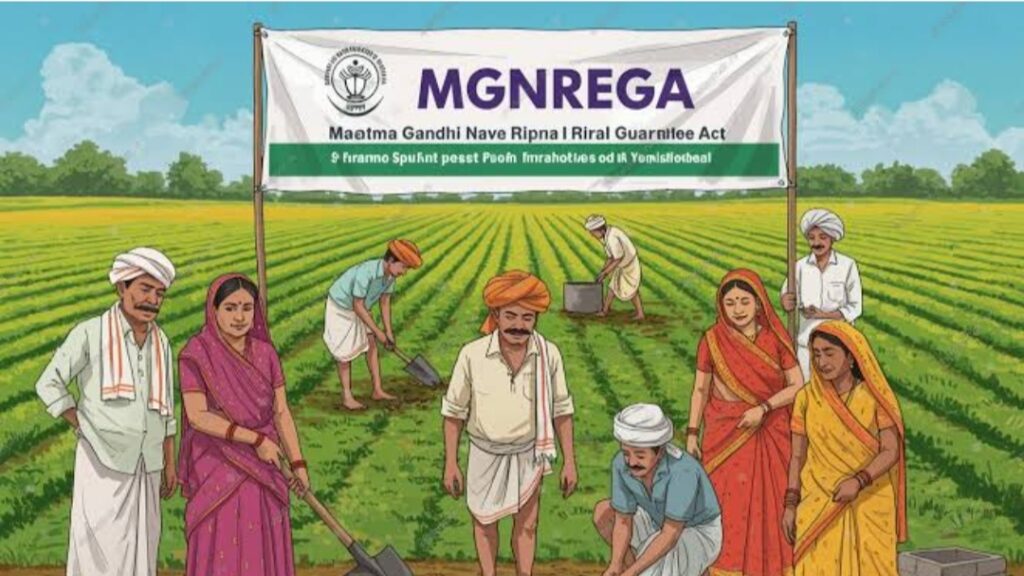
The Modi government’s decision to replace the Mahatma Gandhi National Rural Employment Guarantee Act (MGNREGA) with the Vikasit Bharat – Guarantee for Employment and Livelihoods Mission (Gramin) Bill, 2025 (VB-G Ramji Bill) is a step forward in implementing these anti-worker labor reforms. This move by the Modi government must be strongly opposed, as this bill completely negates the fundamental character of MNREGA and provides only a limited guarantee of work instead of a universal guarantee of employment. This bill also legally absolves the central government of its responsibility to allocate funds in accordance with state demands. These two provisions—universal guarantee of employment and 100 percent allocation of funds in accordance with state demands—are the lifeblood of MNREGA. The new bill contradicts both of these provisions and will, therefore, destroy employment in rural areas, not create it. (This is the hidden purpose of this bill.) Thus, the world’s largest employment scheme, which had proven its worth even during the Corona crisis and ensured an increase in agricultural growth, was essentially thrown to the wind. The government passed this bill on the strength of its parliamentary majority, and in such haste, it refused to heed the opposition’s advice to refer its provisions to a parliamentary standing committee for further discussion.
MNREGA guarantees 100 days of employment for every rural household without any discrimination. The new bill provides for increasing this from 100 days to 125 days. Introducing this provision in Parliament, the Modi government described it as a “modern alternative to the old MNREGA law” and a “structural reform for rural development in line with the vision of a developed India by 2047.” But this claim is merely a sham. The truth is that this bill, in the name of rationalizing job cards, opens the door to excluding a large segment of rural households from the right to seek employment. Our experience shows that every effort has been made over the past 11 years to weaken MNREGA’s universal employment provision, including inadequate budget allocation, resulting in non-timely payment of wages to workers and their pending payments for months, mandatory linking of these payments to Aadhaar and bank accounts, and directives to digitally record workers’ attendance. In the single month between October and November of this year, the names of 2.7 million laborers were removed from the registration list on the basis of inactivity. Therefore, the provision of 125 days of employment instead of 100 in this new bill is not reassuring. The Modi government’s record over the last 11 years shows that despite the MNREGA’s 100-day employment guarantee, it has provided only 40-45 days of employment on average each year, which is less than the UPA’s average. The new bill even weakens this guarantee.
MNREGA is a demand-driven scheme, but the new bill has completely eliminated it. The 125-day employment will be available in sectors selected by the central government. The criteria for this selection are not mentioned in the bill, and we can easily assume that this selection will be used to serve the BJP’s political needs. Furthermore, the autonomy of gram panchayats in formulating rural development plans will be eliminated, and they will have to work according to the central government’s established guidelines. Thus, the concept of cooperative federalism between the states and the central government, enshrined in the Constitution, will also be buried.
The new bill empowers the government to suspend this employment scheme during the agricultural season, when farm work is at its peak. This provision will deprive rural families of work at a time of greatest need, leaving them at the mercy of landowners. The bill does not define “agriculturally intensive climate.” Our country has diverse climates, leading to the production of diverse crops. Beyond the Rabi and Kharif seasons, there are areas with three cropping seasons, allowing agricultural activities to continue year-round. This provision in the new bill could extend the right to refuse work to most of the year, defeating the very purpose of the employment guarantee. The mandatory digital attendance at work will also create significant hardship for workers, leading to job loss and deprivation of their rights.
Neoliberal policies that facilitate corporate control over natural resources like water, forests, and land have resulted in large swaths of agricultural land being lost from small farmers, reducing them to farm laborers. Furthermore, capitalist development in the agricultural sector has led to increased mechanization. This has led to a significant decline in the number of days of employment for farm laborers, even during the agricultural season. It is a well-known reality in rural areas that, despite legal provisions, women are still not paid equal wages to men in agricultural work, and their wages are up to 40 percent lower. MNREGA has provided support to such farm laborers, providing them with alternative employment options if work in the fields is not available at reasonable wages even during the agriculturally intensive season. This new bill is taking away this means of survival from the rural poor, especially those affected. With increasing mechanization and a decline in average days of employment, the absence of MNREGA will lead to a significant decline in wages, especially for women, and intensify exploitation by landowners.
Numerous studies on MNREGA have shown that it has increased the income of the rural poor by 10 percent. The scheme has also boosted the self-respect of poor villagers, increasing their collective bargaining power. Consequently, regardless of whether they find employment under MNREGA, they have refused to work elsewhere at lower wages. The propaganda that MNREGA has prevented the availability of agricultural laborers is precisely because poor villagers are no longer willing to work for lower wages. The dominant feudal class views this as a direct challenge from the poor villagers. The Modi government’s “Ji Ram Ji” bill will serve to break this very power of the rural poor, created by MNREGA.
The proposed change in the funding pattern for rural employment will also deprive workers of employment. The bill reduces the central government’s responsibility for wage payments from the current 100 percent to a 60:40 sharing with the states. It also shifts the responsibility for unemployment allowance and compensation expenditure to the states. Furthermore, a provision for “normative allocation” is being introduced, meaning that the central government will set state-wise maximum spending limits on employment programs, and states will have to bear the cost of spending beyond this limit.
Until now, the central government has allocated only ₹60,000-70,000 crore for this scheme. According to experts, this budget allocation for MNREGA is too low, and this is the reason for many of the problems and shortcomings associated with the scheme. Now, with the supposedly increased employment days, to maintain the scheme’s standards, a budget allocation of at least ₹1 lakh crore will be required, and as per the provisions of the bill, 40 percent of this, or approximately ₹40,000 crore, will have to be borne by state governments. This will place an unbearable financial burden on already financially distressed state governments, while the central government has already usurped the entire source of state financial resources. This will lead states to avoid creating rural employment opportunities. If the Modi government shares the current central allocation with the states, it will be difficult to maintain the scheme’s current quality, as this approach will further limit the program’s scope and reduce central accountability.
The farmers’ movement in our country is continuously agitating for 250 days of employment under this scheme and demanding a wage rate of ₹750. The Parliamentary Standing Committee has also recommended a minimum MNREGA wage of ₹400 per day. Ignoring this, the Modi government has, in its own way, set a minimum wage of ₹240 per day, even though the wage rates in many states, including BJP-ruled states, are much higher. Therefore, this minimum wage will encourage many states to reduce wages for this employment scheme or remain stagnant at the prevailing wage rates in those states for a long time. The reality is that the wages paid under MNREGA are even lower than the minimum wage declared for unskilled workers in the unorganized sector in cities. Despite this, the BJP government is promoting corporate interests at the expense of the livelihoods of the rural poor. Therefore, naming this bill the Employment and Livelihood Mission (RAM) is ridiculous, but this name is being used to mislead the public and communally polarize society. Changing names and lowering the quality of work has become the hallmark of this government.
The modernization of MNREGA that the Modi government has touted in introducing this bill in Parliament did not require the abolition of MNREGA. It could have easily achieved this by consulting political parties, trade unions, and organizations of the rural poor, and by amending the MNREGA rules with broad consensus. This would have strengthened MNREGA and ensured its effective implementation as a universal and demand-based employment guarantee. However, the government’s real objective is to destroy this very character of MNREGA. Therefore, this new bill, taken as a whole, nullifies Articles 21 and 23 of the Constitution, which guarantee its citizens the right to earn a livelihood with dignity.
Mahatma Gandhi spoke of wiping the tears of those at the bottom of society. The MNREGA, enacted after pressure from leftist parties on the then UPA government, was an effort to achieve this. It has provided livelihood support to tribals, Dalits, and economically weaker sections. However, to serve the interests of corporations, the Modi government has reduced Mahatma Gandhi’s goal to “Jai Ram Ji.”
Sanjay Parate is the Vice President of Chhattisgarh Kisan Sabha, affiliated to All India Kisan Sabha
Disclaimer: These are the personal opinions of the author