Research and Innovation Form the Backbone of Sustainable Agripreneurship: Prof Chandel
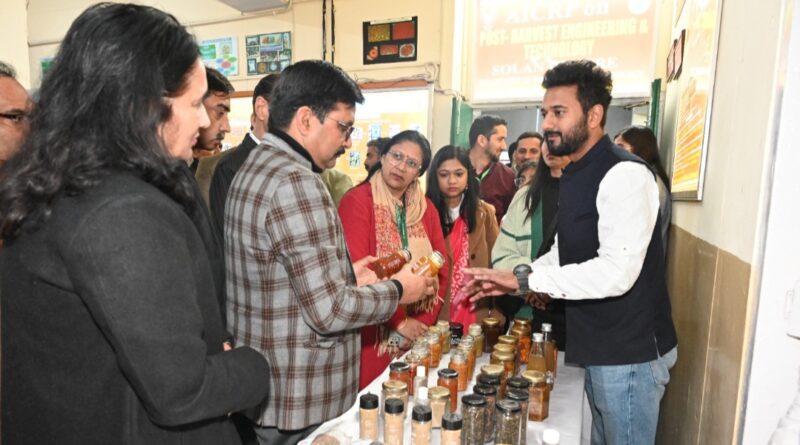
A 21-day ICAR-sponsored Winter School on ‘Fostering Agripreneurship through Processing and Optimized Value Chains for Horticultural Crops Integrated with Circular Strategies for Waste Upcycling and Economic Resilience’ commenced today at Dr YS Parmar University of Horticulture and Forestry, Nauni. The programme is being organized by the Department of Food Science and Technology.
Addressing the participants and students, Vice Chancellor Prof. Rajeshwar Singh Chandel emphasized that research and innovation are the backbone of sustainable agripreneurship in the horticultural sector. He noted that despite high production potential, horticultural crops are highly perishable and suffer significant post-harvest losses due to inadequate handling, storage, and processing infrastructure.
Prof. Chandel highlighted that horticulture has emerged as one of the most dynamic sectors of agriculture, offering immense opportunities for income enhancement, employment generation and nutritional security. However, realizing this potential requires a paradigm shift from production-oriented farming to enterprise-driven and market-linked agripreneurship. He pointed out that post-harvest losses, estimated at up to 30 percent, remain a major concern, resulting in economic losses and wastage of valuable resources.
Stressing the need for scientific interventions across the value chain, he urged scientists to identify their unique strengths (USP) and guide young researchers towards developing scalable, marketable, and patentable technologies, while moving beyond over-dependence on western validation.
Special Guest and Keynote Speaker, Dr Sunil Pareek, Dean (Postgraduate Studies), NIFTEM, Sonipat, observed that while the overall ecosystem has improved, several initiatives still need focused attention. Emphasizing the need for indigenous (swadeshi) technologies, he said that businesses cannot survive without adopting the latest technologies, but not every western innovation is suitable for Indian conditions. He called upon scientists to identify local problems and collaboratively develop local solutions.
Earlier, Dr Devina Vaidya, Director of Research, stated that scientific interventions are essential to enhance efficiency, quality, and profitability across the horticultural value chain. She added that advances in post-harvest technology, food processing, biotechnology, and bioengineering have opened new avenues for converting horticultural produce and residues into high-value products. She emphasized the critical role of universities in equipping scientists, students, farmers, and entrepreneurs with practical skills in post-harvest management, processing technologies, packaging, quality assurance, and marketing.
Dr Manish Sharma, Dean, College of Horticulture, said that transforming horticulture into a competitive and sustainable agribusiness sector depends largely on the availability of skilled human resources and strong entrepreneurial leadership. He noted that the focus of agriculture has shifted towards processing, value addition, market integration and capacity building, making hands-on training increasingly important.
Welcoming the participants, Dr Rakesh Sharma, Head, Department of Food Science and Technology, informed that 19 participants from 10 universities and two KVKs from Odisha, Andhra Pradesh, Uttar Pradesh, Haryana, Punjab, Gujarat and Himachal Pradesh are taking part in the programme. He stated that the Winter School aims to sensitize the scientific community towards agripreneurship through processing, optimized value chains, waste upcycling and economic resilience, in alignment with national priorities of sustainability, climate resilience and self-reliant agriculture.
He further added that the programme emphasizes strong collaboration among research institutions, start-ups, FPCs, SHGs and policy support systems to translate laboratory innovations into field-level impact. As part of the training, several expert sessions and exposure visits have been planned to the Model Farm, Natural Farming Model, HimAgri Solutions Unit, Dilman Delicacies, Minchy’s, Directorate of Mushroom, KVK Kandaghat, and RHRTS Mashobra, Shimla.