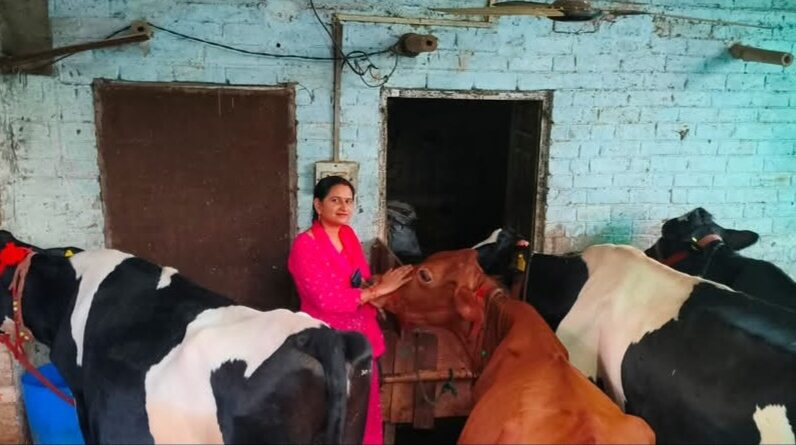
From Classroom to Cowshed: How Sonika’s ‘Smart Work’ is Churning a Dairy Revolution
In the quiet mornings of Ghumarwin, as most of the village still stirs awake, Sonika is already well into her day. But her first shift doesn’t involve textbooks or a classroom. Dressed in comfortable clothes, she moves efficiently among her beloved cows, the gentle hum of a milking machine replacing the morning school bell. This is where her second, equally passionate, career begins.
Sonika, a TGT Science teacher at a private school in Ghumarwin, is redefining what it means to be self-reliant. She isn’t just educating young minds; she’s building a thriving dairy enterprise from the ground up, proving that passion and precision can create an incredible success story.
Her journey started modestly in 2019 with a single Jersey cow. Today, her farm is a picture of rural modernity, home to six cows and a heifer. What makes her story stand out is her methodical, “smart work” approach. She runs her farm with the precision of a science lesson, employing a modern milking machine, a chaff cutter for fodder, and regularly consulting with veterinarians.
“People often think dairy farming is an all-day, back-breaking chore. It doesn’t have to be,” Sonika shares with a confident smile. “My first shift is from 5:30 to 7:00 AM, and my husband is right there with me. In the evening, it’s just another hour and a half. With family support, it’s completely manageable, even with my teaching job.”
This efficient routine is yielding sweet results. Her farm produces about 57 liters of milk daily. Sold at ₹65 per liter, this translates to a gross monthly income of nearly ₹1.1 lakh. After expenses, Sonika takes home a net profit of approximately ₹74,000, making her dairy farm not just a passion project, but a highly profitable business.
She is a firm believer that others can follow her path. “You don’t need a huge farm to start. Even one or two cows can empower a woman or a young person economically. It’s a sustainable model for financial independence,” she asserts.
Sonika’s success is also bolstered by state government policies. The Minimum Support Price (MSP) for milk ensures a stable and remunerative market. “The MSP has been a game-changer. Our milk gets a good price, and it sells easily,” she adds.
Echoing the supportive environment, Dr. Kishori Lal Sharma, Assistant Director of the Animal Husbandry Department, highlighted the government’s initiatives. “We are providing an incentive of ₹3 per liter for milk sold to registered societies. Furthermore, a subsidy of ₹2 per liter is available for those transporting milk from over two kilometers,” he explained. He also noted that 15 new milk producer societies have been formed in Bilaspur, expanding the network for local farmers.
The Deputy Commissioner of Bilaspur, Rahul Kumar, reinforced this message, encouraging more farmers to explore dairy farming. “The government is committed to supporting our farmers through various schemes. Dairy farming presents a tremendous opportunity to strengthen the rural economy, and we urge more people to avail themselves of these benefits,” he stated.
But for anyone visiting Sonika’s farm, the most powerful message isn’t just in the numbers or the policies—it’s in her calm determination. Her advice to the youth and women of Himachal is simple yet profound: “Do smart work, become self-reliant. You can build a strong future for your family, right here at home.”
In Sonika’s world, the science of teaching and the art of dairy farming blend seamlessly, creating a powerful formula for empowerment that is inspiring an entire region.