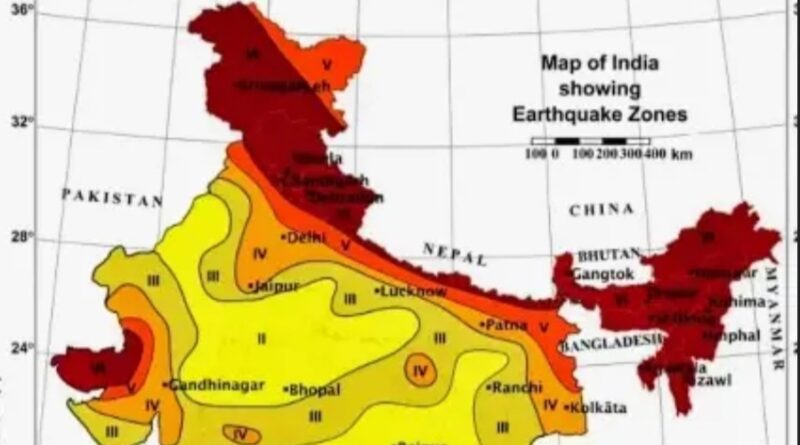
Himachal Pradesh Now in India’s Highest Earthquake Risk Zone
Himachal Pradesh has officially been placed in India’s most dangerous earthquake-risk category, Zone VI, after the Bureau of Indian Standards (BIS) unveiled its updated national seismic zonation map. This marks a historic shift for the hill state, which until now was split between Zones IV and V depending on district-level geology.

A Century of Seismic Mapping
India’s earthquake-risk mapping has been evolving for nearly 100 years. The first national seismic map was drawn up in 1935, following the devastating Bihar–Nepal earthquake of 1934. The last major update came in 2002 under IS 1893:2002, which guided building codes and disaster planning for more than two decades.
What’s New in 2025
The latest BIS Earthquake Design Code 2025 introduces a cutting-edge scientific approach called Probabilistic Seismic Hazard Assessment (PSHA). Unlike older methods, PSHA uses advanced modeling to better predict earthquake risks. For Himachal Pradesh, this means every district—from Kangra and Kullu to Shimla and Lahaul–Spiti—is now uniformly classified under Zone VI, the highest-risk category.
What This Means for the State
- Uniform risk classification: Earlier, districts like Kangra, Chamba, and Mandi were in Zone V (highest risk), while Shimla, Solan, and Una were in Zone IV (slightly lower risk). That distinction no longer exists.
- Legal implications: The new map doesn’t instantly change construction rules, but it sets the official baseline for disaster management, infrastructure audits, and land-use planning.
- Future planning: State and district authorities are legally required to align their disaster-management strategies with these updated national standards.
Experts Weigh In
Specialists say the old Zone IV and Zone V categories are now obsolete for Himachal. With the entire Himalayan arc placed in Zone VI, future policies and safety guidelines will have to reflect this heightened risk.
What Happens Next
For now, the BIS map is a scientific document, not a regulatory order. Actual changes to building codes, compliance checks, or planning laws will only come after formal adoption by government authorities. Still, this is the first time Himachal Pradesh has been uniformly placed in the highest seismic-risk category—a reminder of the fragile geology beneath its breathtaking landscapes.