Centre has not kept any shortfall in Himachal’s budget, Congress govt should stop misleading: Anurag
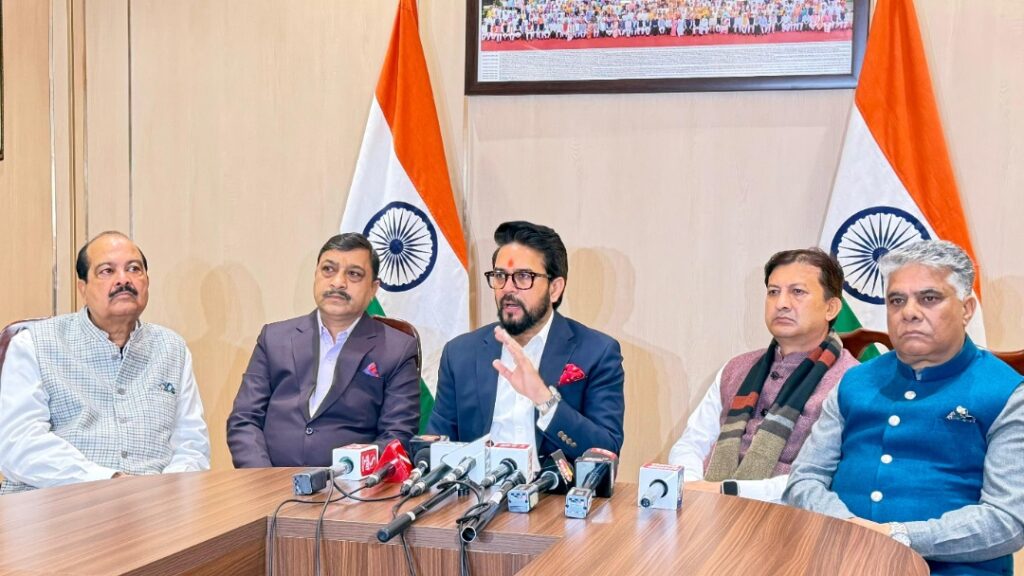
A delegation of Members of Parliament from Himachal Pradesh held a detailed press conference in New Delhi today, highlighting the significantly higher transfers and development investments made to Himachal Pradesh by the Central Government during 2014-2026, compared to the period 2004-14. The delegation was led by Shri Anurag Singh Thakur, Member of Parliament from Hamirpur Parliamentary Constituency, and was graced by the presence of Shri Suresh Kashyap, Member of Parliament from Shimla Parliamentary Constituency, Shri Rajiv Bhardwaj, Member of Parliament from Kangra Parliamentary Constituency, Shri Harsh Mahajan, Member of Rajya Sabha, and Shri Sikander Kumar.
The MPs presented evidence of central assistance to Himachal at the press conference, ranging from sector-wise tax devolution and Finance Commission findings to infrastructure projects and new central institutions, to show how centrally sponsored assistance has boosted investment and connectivity in the state.
Mr. Anurag Singh Thakur said, “From 2014 until now, the central government has generously helped Himachal. Modi ji restored Himachal’s special status, which was taken away during the UPA regime. Congress is attempting to mislead the public. Himachal’s share of central taxes from 2004 to 2014 under the UPA government was only ₹12,639 crore, whereas under the Modi government, it increased to ₹76,799 crore between 2014 and 2026. During the UPA regime, Himachal received a total grant-in-aid of ₹50,298 crore from the center, which increased to ₹1.41 lakh crore during the Modi government’s tenure from 2014 to 2024.”
Currently, under the new Finance Commission formula, Himachal’s share of net federal taxes has increased from 0.830% (based on the 15th FC) to 0.914% under the 16th FC, representing a structural increase. Central funds released to the State of Himachal Pradesh under the PMGSY during fiscal years 2004-05 to 2013-14 were ₹1,549.15 crore, which increased to ₹6,895.89 crore during fiscal years 2014-15 to 2025-26 (up to 04.02.2026).
Mr. Anurag Singh Thakur said, “On our behalf, all of us MPs request the Chief Minister of Himachal and the Congress government to come to Delhi and meet with the Finance Ministry to reduce the high interest rates on the loans you have taken, to ease the burden on Himachal. We love our Himachal and instead of resorting to blame politics, bring reforms and we are ready to support you. Recently, the Chief Minister of the Congress-ruled state of Telangana, Mr. Revanth Reddy, came to Delhi with a similar problem in his state, and the Prime Minister and the Finance Minister helped him, and Reddy mentioned in the Telangana Assembly that the central government had helped him. We believe in cooperative federalism, and if Telangana can do it, why can’t Himachal?”
Shri Anurag Singh Thakur said that the Centre’s approach to capital assistance for hill states has also changed. The Special Assistance to States for Capital Investment (SASCI) provided interest-free 50-year loans and allocated approximately ₹8,309 crore to Himachal from 2020-21 to January 2026, a figure that did not exist in the previous period. Finance Commission-linked local body grants have also increased significantly for Himachal, with rural local bodies receiving ₹3,744 crore under the 16th FC alone, almost double the ₹1,673 crore in the 15th FC.
Shri Anurag Singh Thakur said, “Central institutions established in Himachal since 2014 and subsequent funding and projects include AIIMS Bilaspur (costing ~Rs.1,470+ crore), Central University of Himachal Pradesh (Rs.500 crore), IIM Sirmaur (Rs.531.75 crore), IIIT Una (Rs.64 crore), several new medical colleges in Chamba/Hamirpur/Nahan (Rs.700 crore), and Industrial Development Scheme assistance (Rs.1,164 crore approved in September 2023). Among the industrial projects, the Una Bulk Drug Park (Rs.1,000 crore central funding) and the Nalagarh Medical Devices Park were highlighted, which are catalytic projects for job creation and strengthening the state’s manufacturing base.”
The MPs highlighted the huge leap in connectivity projects compared to the prior decade. Under Railways, the Centre has allocated ₹2,911 crore in 2026-27 alone and approved four major new rail track projects over the years, with 255 km of new track under construction (estimated cost ₹13,168 crore), as well as 24 rail flyovers/underbridges completed in 2024-26. New lines named in the briefing include: Nangal-Una-Talwara, Bhanupali-Bilaspur-Beri, Chandigarh-Baddi, and Kangra Gauge Restoration; four stations are being developed under the Amrit Bharat Station Scheme. Under Highways, more than 2,600 km of national highways have been built in the state by June 2025, and major NH sections (such as Kiratpur-Nerchowk) have been inaugurated by the Prime Minister.
Mr. Anurag Singh Thakur explained that “The 16th FC revised the weights of parameters, for example, increasing the weight of population (2011), reducing the weight of area from 15% to 10%, and adding a new “contribution to GDP” parameter (10%). These adjustments increased Himachal’s share from 0.830% to 0.914%, and projected annual transfer receipts in 2026-27 to increase from ₹11,561.66 crore in 2025-26 to ₹13,947 crore, an increase of over ₹2,300 crore. The MPs used data to show that several states, including several opposition-ruled states, are seeing increased shares under FC-16, underscoring the fair, formula-based nature of the change.”
Shri Anurag Singh Thakur said, “Himachal Pradesh’s devolution has not decreased, but increased. Contrary to the Congress’s hollow claims of “unjust cuts,” the 16th Finance Commission has increased Himachal Pradesh’s share of the divisible pool from 0.830% in the 15th Finance Commission to 0.914%. Under the new formula, Himachal’s post-devolution receipts have increased from approximately ₹11,561.66 crore in the Budget Estimates (BE) for 2025-26 to ₹13,949.97 crore, an increase of approximately ₹2,388 crore. This is a significant increase in central tax devolution. The RDG was front-loaded under the 15th Finance Commission to help states recover from COVID and was explicitly designed as a time-bound, transitional measure aimed at achieving near-zero revenue deficit by 2025-26. The 16th Finance Commission reviewed the results and concluded. It concluded that despite large RDG transfers under the 14th Finance Commission and the 15th Finance Commission, the actual revenue deficit did not move toward normal because many states did not strengthen revenue collection or rationalize expenditure. The 16th Finance Commission therefore considered the continuation of normal RDG counterproductive, as it could create perverse incentives and reduce the pressure for structural reforms.
Mr. Anurag Singh Thakur explained that the Modi government does not discriminate against states. Several opposition-ruled states also benefited from devolution under the 16th Finance Commission formula. The horizontal redistribution introduced by the 16th Finance Commission reweighted criteria, increasing the weighting of population/demographic performance and adding a 10% weighting to GDP contribution, while reducing the weighting of area. This benefited many states, including several opposition-ruled states, while others suffered losses. Therefore, the 16th Finance Commission’s adjustments cannot be characterized as a biased exercise.
Shimla, 5 February 2026
Today a delegation of Himachal Pradesh Members of Parliament held a detailed press conference in New Delhi to highlight the significantly larger transfers and development investments the Central Government has delivered to Himachal Pradesh during 2014–2026 compared with the 2004–14 period. The delegation was led by Anurag Singh Thakur and included Suresh Kashyap, Rajeev Bharadwaj, Harsh Mahajan and Sikander Kumar. The MPs set out sector-by-sector evidence, from tax devolution and Finance Commission outcomes to infrastructure projects and new central institutions, to demonstrate how Centre-sponsored support has accelerated investment and connectivity across the State.
Shri Anurag Singh Thakur started with tax devolution and Central transfers. Under the new Finance Commission formula Himachal’s share of net union taxes rises from 0.830% (15th FC basis) to 0.914% under the 16th FC, a structural uplift that translates into a materially larger tax-devolution flow for 2026–27 (Budget Estimate Rs. 13,949 crore). Over the entire 2014–26 window, the State’s cumulative tax devolution reached roughly Rs. 76,799 crore while grants-in-aid totaled about Rs. 1.41 lakh crore, very large increases in comparison to the 2004–14 decade figures of 12,699 crores in tax devolution and 50,298 crores in grants in aid.
Shri Anurag Singh Thakur explained the Centre’s posture toward capital support for hill states has also changed: the Special Assistance to States for Capital Investment (SASCI) provided interest-free 50-year loans and delivered about Rs. 8,309 crore to Himachal between 2020–21 and Jan 2026, a new source of long-term financing not present in the earlier period. Finance Commission linked grants for local bodies have also risen sharply for Himachal, with rural local bodies alone getting Rs. 3744 crores under 16th FC almost double from Rs. 1673 crore of 15th FC. Shri Thakur explained how Central institutions have been established in Himachal since 2014 and the funds and projects that followed. Key projects were AIIMS Bilaspur (cost ~Rs.1,470+ crore), the Central University of Himachal Pradesh (500cr), IIM Sirmaur (531.75 crore), IIIT Una (Rs 64 crore), several new medical colleges in Chamba/Hamirpur/Nahan (700cr) and the Industrial Development Scheme assistance (Rs.1,164 crore approved in Sept 2023). In industrial projects the Una bulk drug park, a Rs.1,000 crore central funding and Nalagarh medical devices park, were highlighted as catalytic projects that both create jobs and deepen the State’s manufacturing base.
The MPs stressed a quantum leap in connectivity projects compared with the earlier decade. Under Railways the Center has allocated Rs. 2,911 crore for rail in 2026–27 alone and sanctioned four major new rail-track projects over years, with 255 km new tracks under construction at an estimated cost of ~Rs.13,168 crore, plus 24 rail flyovers/underbridges completed during 2014–26. New lines named in the briefing include Nangal–Una–Talwara, Bhanupali–Bilaspur–Beri, Chandigarh–Baddi and Kangra gauge restoration; Four stations are being developed under the Amrit Bharat Station scheme. Under Highways, over 2,600 km of national highways have been constructed in the State as of June 2025, and major NH sections (eg, Kiratpur–Nerchowk) were inaugurated by the Prime Minister. Shri Thakur explained The 16th FC revised the weights of criteria, for example, population (2011) increases its weight while area’s weight falls from 15% to 10% and a new “contribution to GDP” parameter (10%) is introduced. These adjustments raised Himachal’s share of the divisible pool from 0.830% to 0.914% and, on estimates, lifted annual devolution receipts in 2026–27 by over 2300 crores to 13,947 cr from 11,561.66cr in 2025–26. Shri Anurag Singh Thakur used data to show how many States, including several opposition-ruled States, also see increased shares under FC-16, underscoring the impartial, formula-driven nature of the change.
A key part of the press conference addressed the discontinuation of Post-Devolution Revenue Deficit Grants (RDG) under FC-16. Anurag Singh Thkaur read FC-16’s assessment, RDGs under FC-14/FC-15 was intended as a temporary, front-loaded transition tool, especially to address COVID shocks with the expectation that recipient States would use the period to improve tax effort and rationalize expenditures and thereby approach near-zero revenue deficits by 2025–26. FC-16 finds that, despite large RDG transfers, many recipient States did not follow the normative corrective path; the Commission therefore judged RDG to have become a perverse, permanent support and discontinued it. Shri Thakur pointed to Himachal’s specific fiscal metrics used by FC-16 to justify this treatment: Himachal’s own-tax revenue (~5.6% of GSDP) trails better-performing peer states, revenue expenditure is relatively high (~21% of GSDP), fiscal deficit widened (~5.3% of GSDP in 2023–24) and outstanding liabilities are elevated (~42–43% of GSDP), all factors the Commission used to assess grant eligibility. He also highlighted how Himachal’s capital expenditure of 10.5% is very less compared to other states.
Shri Anurag Singh Thakur requested the Himachal Government to release its share of funds promptly for ongoing rail projects and other Centre-supported schemes, arguing that slow state co-funding delays project completion and reduces the State’s development dividend.
Shri Anurag Singh Thakur formally invited the Himachal Chief Minister, Sukhvinder Singh Sukhu, to visit New Delhi to meet Finance Minister Nirmala Sitharaman and Prime Minister Narendra Modi to learn fiscal management lessons and unlock further cooperation, offering Telangana’s recent example, where sitting Congress CM met the Union leadership and later credited those discussions and called PM Narendra Modi as Bade Bhai for helping Telangana. Shri Anurag Singh Thakur reaffirmed that Cooperative federalism is the key principle the Modi government follows and requested CM Sukhu to come to Delhi.